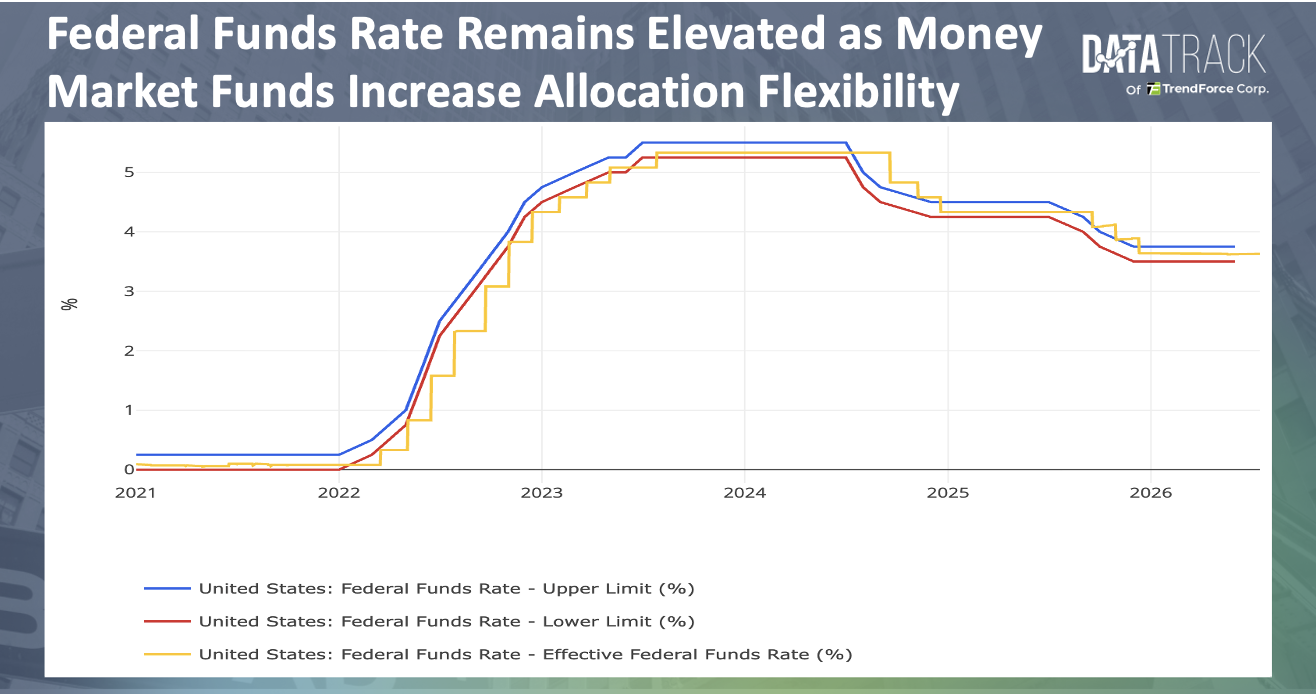
U.S. money market fund assets remain near historical highs, but fund managers are changing how they allocate capital. According to the Investment Company Institute’s weekly market-wide statistics, total U.S. money market fund assets stood at US$7.89 trillion in the week ended July 15, 2026, down US$59.9 billion from the previous week. By fund type, government money market funds held US$6.51 trillion in assets. By investor type, institutional funds held approximately US$4.81 trillion, accounting for about 61% of the total, indicating that cash management demand from corporations and institutional investors remains an important source of market support.
While total assets remain elevated, the average maturity of fund holdings has shortened significantly. Crane Data showed that, as of the week ended July 10, the weighted average maturity of the Crane Money Fund Average declined from 42 days one month earlier to 38 days, while that of the Crane 100 Money Fund Index shortened from 44 days to 40 days. Funds are increasing portfolio liquidity and reinvestment speed to cope with continued uncertainty surrounding the Federal Reserve’s policy direction.
Uncertain Interest Rate Outlook Prompts Funds to Preserve Reinvestment Flexibility
Money market funds primarily invest in short-term U.S. government debt, repurchase agreements, floating-rate notes, and other short-term credit instruments. Under U.S. Securities and Exchange Commission regulations, a fund portfolio’s weighted average maturity may not exceed 60 days, while its weighted average life may not exceed 120 days, helping to control interest rate and liquidity risks.
Shortening maturities allows funds to recover principal more quickly and reallocate it at prevailing market rates. If a fund holds three-month or six-month Treasury bills and short-term yields subsequently rise, the existing positions will continue to earn the yields locked in at the time of purchase, preventing the fund from immediately capturing the new, higher returns. Increasing exposure to overnight and very short-term assets can reduce the opportunity cost of being locked into lower yields, but it also causes fund returns to follow changes in money market rates more quickly.
Funds Shift From Fixed-Rate Treasury Bills Toward Repurchase Agreements and Floating-Rate Notes
The shortening of maturities is already reflected in actual holdings. Asset allocation data from the fund sample tracked by Crane Data showed that, as of the end of June 2026, the sample funds’ holdings of U.S. Treasury bills declined by US$96 billion to US$3.3 trillion, accounting for approximately 39.9% of total holdings. Repurchase agreement holdings increased by US$68 billion to US$3.06 trillion, raising their share to 37.2%. Holdings of U.S. Treasury floating-rate notes, or FRNs, also increased by US$32 billion to US$523 billion.
Repurchase agreements are generally concentrated in overnight or very short maturities, allowing them to reflect money market rates quickly. FRN coupons are periodically reset in line with short-term interest rates. Compared with holding longer-maturity fixed-rate Treasury bills, these two instruments can reduce the risk of being locked into lower yields when interest rates rise, while FRNs can also lower a portfolio’s sensitivity to changes in fixed interest rates. Demand from money market funds for short-term assets has therefore not disappeared. Instead, allocations are shifting toward instruments that mature more quickly or allow interest rates to reset on a floating basis.
Rising Treasury Financing Needs Make Maturity Matching More Important for Short-Term Debt Supply and Demand
The U.S. Treasury estimates that it will borrow US$671 billion in privately held marketable debt from July through September 2026. This estimate covers marketable Treasury securities across different maturities and does not mean that the entire amount will be financed through short-term Treasury bills. The actual maturity structure will depend on subsequent quarterly refunding and auction arrangements. Treasury bills remain one of the Treasury’s key tools for adjusting its cash balance and financing volume.
The Treasury General Account, or TGA, reflects the Treasury’s operating cash balance held at the Federal Reserve and fluctuates with tax receipts, government spending, and debt issuance. Money market funds holding nearly US$8 trillion have substantial capacity to absorb new supply, but as funds shorten portfolio maturities, demand for Treasury bills of different tenors may diverge. If additional Treasury bill supply is concentrated in shorter maturities preferred by money market funds, auctions are more likely to attract sufficient demand. If supply shifts toward longer-dated bills, yields may need to rise to compensate funds for taking on greater yield-locking risk. The outlook for the short-term debt market therefore depends not only on whether overall funding is sufficient, but also on whether the Treasury’s maturity mix aligns with money market fund demand.
Nearly US Trillion Cannot All Be Viewed as Cash Waiting to Enter the Stock Market
Money market funds are often viewed as cash positions that could flow back into stock and bond markets, but their assets include corporate operating cash, institutional liquidity reserves, household emergency funds, and short-term investment positions. Institutional funds account for approximately 61% of total assets, indicating that a large share of the money has clearly defined cash management and payment purposes and cannot easily be redirected into long-term risk assets.
U.S. money market fund assets declined by US$59.9 billion in the week ended July 15, indicating that some investors are adjusting their cash allocations. However, total fund assets remain near historical highs. The more significant change is currently taking place within portfolios, with funds shifting from longer-maturity Treasury bills toward repurchase agreements, shorter-term Treasury bills, and FRNs. This cannot yet be interpreted as a broad withdrawal of capital from the money market.
Money Market Fund Returns and Short-End Allocations Will Reflect Policy Expectations More Quickly
Key indicators to monitor include the weighted average maturity of money market funds, Treasury bill and repurchase agreement holdings, and auction results across different Treasury bill maturities. If funds continue concentrating in overnight and very short-term instruments, portfolio returns will reprice more quickly with market interest rates. Capital movements among repurchase agreements, short-term Treasury bills, and FRNs may also affect relative yields across different short-end instruments.
Money market funds holding nearly US$8 trillion remain an important source of funding for the U.S. short-term financing market. The central change reflected by shorter maturities is that this large pool of cash is increasing liquidity and reducing fixed-rate exposure. As Treasury financing needs rise, money market fund allocation choices among Treasury bills, repurchase agreements, and floating-rate notes will have a more direct impact on the relative demand, yields, and funding costs of short-end assets.