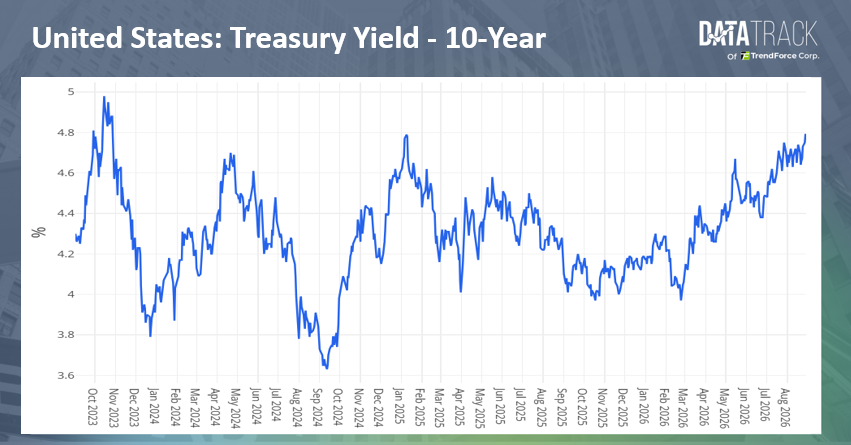
Global bond markets have just endured their sharpest selloff in nearly two decades, with long-dated yields surging in lockstep across four major developed markets rather than moving as an isolated national story: the US 10-year Treasury yield has climbed to its highest since November 2023, Japan's 10-year yield has pushed above 3%, UK gilt yields have hit a post-2008 peak, and Germany's 10-year yield has reached its highest since 2011. Robin Brooks, a senior fellow at the Brookings Institution, called this "the continuation of a medium-term trend that'll keep going for many years," rather than a fleeting swing. The selloff, which began building late summer, accelerated through the first days of September as an oil-price shock reignited inflation concerns, signaling that markets are repricing for a structurally higher-for-longer rate regime rather than an ordinary cyclical move.
No single factor explains this shift; rather, fiscal, industrial, and geopolitical forces are converging at once. Heavy government bond issuance across major economies, combined with an oil-price shock reigniting inflation concerns, has pushed markets to expect tight monetary policy to persist longer than previously assumed. Natalia Lojevsky, managing director at CIFC Asset Management, argues that heavy debt issuance and inflation risk mean yields still have room to climb further. At the same time, the AI infrastructure boom is driving companies to issue debt at scale; Larry Holzenthaler, senior portfolio manager at Catalyst Funds, put it plainly: "You have an enormous amount of debt being issued to fund different AI projects." Risk is not evenly distributed across developed markets: Masahiko Loo, senior fixed income strategist at State Street Investment Management, named France as the most vulnerable developed economy, citing fiscal slippage and political gridlock, while Japan faces its own strain, with government debt exceeding 200% of GDP and debt-servicing costs projected to consume more than a quarter of fiscal 2026 government spending.
Looking ahead, Deutsche Bank projects the US 10-year Treasury yield could reach roughly 5.5% within a year, and around 6.4% on a two-year horizon, a level at which bonds would likely deliver negative total returns, suggesting the market's repricing for structurally higher rates has only just begun. In the near term, long-end yields are unlikely to retreat meaningfully unless oil prices and inflation data show clear signs of cooling; over the medium term, commercial real estate, private-equity-backed companies, and weaker software businesses are likely to be among the first to feel the strain of higher borrowing costs.