U.S. government financing needs continue to rise, but the Treasury has chosen to hold off on expanding medium- and long-term debt issuance. In its quarterly refunding announcement released on August 5, 2026, the U.S. Treasury said it expects to maintain the current auction sizes of nominal coupon securities and Floating Rate Notes (FRNs) for at least the next several quarters, with additional financing needs to be met primarily through Treasury bills (T-bills) maturing within one year.
“T-bill and chill” is a term used by market traders to describe this issuance strategy and is not an official Treasury policy name. With coupon security auction sizes temporarily held steady, a larger share of marginal financing needs is being absorbed by T-bills, while medium- and long-term Treasury issuance continues at the existing pace.
As of August 5, 2026, total U.S. public debt stood at approximately US$39.83 trillion, including about US$32.10 trillion in debt held by the public, putting the US$40 trillion threshold within close reach. Greater reliance on short-term financing helps limit immediate pressure on the long end of the Treasury market, but it also shortens the maturity profile of government debt, requiring more frequent refinancing and making interest costs more responsive to Federal Reserve policy and money-market conditions.
Rising Borrowing Needs Push More Financing Toward T-bills
The Treasury’s unchanged issuance guidance covers nominal coupon securities ranging from 2-year to 30-year maturities, as well as 2-year FRNs. The August quarterly refunding totals US$125 billion, comprising US$58 billion of 3-year notes, US$42 billion of 10-year notes, and US$25 billion of 30-year bonds. After refinancing approximately US$96.3 billion of privately held securities maturing around the same period, the operation is expected to raise about US$28.7 billion in new cash.
Quarterly refunding accounts for only part of the government’s overall borrowing needs. The Treasury estimates that it will need to borrow US$739 billion in privately held net marketable debt from July through September 2026, US$68 billion more than projected in May, mainly due to lower expected net cash inflows. Borrowing needs for October through December are estimated at US$628 billion. Treasury estimates provided to the Treasury Borrowing Advisory Committee show that, with auction sizes for nominal coupon securities, FRNs, and Treasury Inflation-Protected Securities (TIPS) held unchanged, T-bills would absorb a substantial share of incremental financing requirements.
| Period |
Privately Held Net Marketable Borrowing |
Net Non-Bill Marketable Issuance |
Assumed Buybacks |
Implied T-bill Financing |
| Jul.–Sep. 2026 |
US$739 billion |
US$375 billion |
US$45 billion |
US$409 billion |
| Oct.–Dec. 2026 |
US$628 billion |
US$361 billion |
US$50 billion |
US$317 billion |
Note: Non-bill marketable securities include nominal coupon securities, FRNs, and TIPS. Implied T-bill financing is calculated by the Treasury based on current auction-size assumptions and does not represent a predetermined issuance target.
Strong Demand for Short-Term Debt Temporarily Eases Long-End Supply Pressure
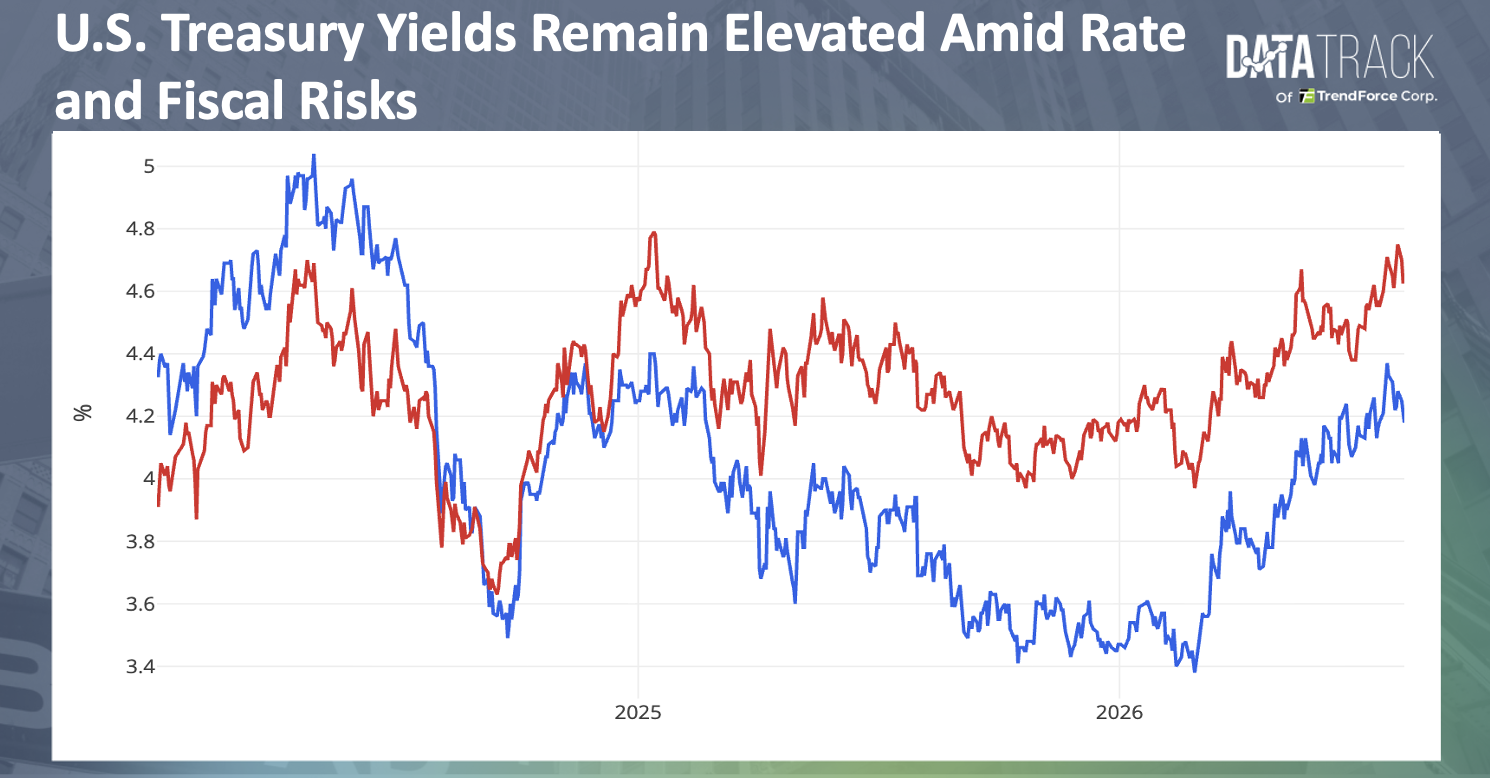
The Treasury’s preference for T-bills partly reflects the cost of long-term financing and the market’s capacity to absorb additional duration. Ahead of the quarterly refunding meeting, Treasury yields had risen significantly as markets repriced energy prices, inflation risks, and the Federal Reserve policy outlook. The Treasury Borrowing Advisory Committee (TBAC) noted that 10-year and 2-year Treasury yields had risen to approximately 4.6% and 4.2%, respectively, while markets also assigned a higher probability to future rate hikes.
Increasing the supply of 10-year or 30-year Treasuries when long-term yields are already elevated could require higher yields to attract sufficient demand and could raise mortgage, corporate bond, and other long-term financing costs through Treasury benchmark pricing. By comparison, T-bills have short maturities and high liquidity and are widely held by money market funds, banks, and corporate cash-management departments, making additional supply easier for short-term funding markets to absorb.
T-bills also provide greater flexibility for cash management. The Treasury can frequently adjust auction sizes across different maturities in response to tax receipts, government spending, debt maturities, and cash balances. For example, the Treasury expects to reduce some short-term bill issuance in September as corporate and non-withheld tax payments flow in, before increasing issuance again in October as seasonal spending rises.
T-bills Reach 22.2% of Marketable Debt, Increasing Refinancing and Repricing Risks
Treasury materials show that T-bills accounted for approximately 22.2% of outstanding marketable Treasury debt as of July 31, 2026, above the upper end of the 15%–20% medium- to long-term range recommended by TBAC in 2020. The denominator for this ratio includes T-bills, nominal coupon notes and bonds, TIPS, and FRNs. It therefore differs from total public debt, which is approaching US$40 trillion and also includes intragovernmental holdings.
A T-bill share above 20% does not imply that the United States is facing an immediate liquidity or default crisis. The expansion of money market funds, increased Federal Reserve holdings of T-bills, and strong demand for highly liquid assets continue to support the market’s capacity to absorb additional supply. The more relevant issue is that a shorter maturity structure forces the government to issue new debt more frequently to repay maturing principal.
Fixed-rate 20-year or 30-year Treasuries can lock in borrowing costs for decades, while T-bills mature within one year and therefore reprice much more quickly according to prevailing market conditions. If the Federal Reserve raises rates or short-term funding costs increase, yields on newly issued T-bills would rise rapidly. If the Fed cuts rates, Treasury borrowing costs could also fall more quickly. “T-bill and chill” therefore gives the Treasury greater issuance flexibility at the cost of more frequent refinancing and greater volatility in interest expenses.
Changes in money market fund flows, bank reserves, or Federal Reserve balance-sheet policy could also affect demand. If such demand weakens, the Treasury may need to offer higher yields to maintain sufficient participation in bill auctions. The strategy reduces immediate long-end supply pressure while shifting more risk toward short-term rates and money-market liquidity.
Issuance Language Shifts to “Changes,” Leaving Room for Higher Coupon Issuance in 2027
The Treasury maintained its guidance that nominal coupon and FRN auction sizes are expected to remain unchanged for at least the next several quarters, but its wording regarding future issuance changed. The May quarterly statement referred to evaluating potential future “increases” in auction sizes, while the August statement adopted the more neutral term “changes.”
“Changes” could encompass increases, reductions, or a redistribution of issuance across maturities, providing the Treasury with greater policy flexibility than the previous wording. The shift does not indicate that the Treasury has already decided to alter long-term issuance. A more appropriate interpretation is that the Treasury is reducing the constraints created by its forward guidance and preserving room for potential issuance adjustments in fiscal 2027.
Treasury meeting materials indicate that current auction sizes should be sufficient to meet financing needs through the remainder of fiscal 2026. However, based on the median primary dealer forecast for privately held net marketable borrowing, and assuming current coupon security auction sizes and privately held T-bill supply remain unchanged, the cumulative financing gap in fiscal 2027 and 2028 could reach approximately US$1.45 trillion.
TBAC therefore believes that the Treasury may need to increase coupon issuance in fiscal 2027 and should update its forward guidance before making actual changes, giving the market sufficient time to absorb additional supply. Market participants expect that, if issuance ultimately needs to rise, the Treasury may initially adjust shorter points on the yield curve, such as 2-year, 3-year, or 5-year notes, to limit the direct impact on long-term term premiums. The Treasury has not yet announced specific maturities or the size of any future increases.
Short-Term Financing Delays Long-End Pressure but Does Not Reduce Overall Funding Needs
“T-bill and chill” allows the Treasury to use strong demand for short-term assets to absorb additional borrowing while avoiding a sudden increase in long-term debt supply when long-end yields are already elevated. It also makes it easier to manage seasonal fluctuations in tax receipts and government spending. However, the strategy addresses the timing and maturity composition of issuance without reducing the fiscal deficit or changing the government’s ultimate funding requirement.
If borrowing needs continue to rise while coupon auction sizes remain unchanged for an extended period, the share of T-bills will continue to increase. If the Treasury eventually needs to close financing gaps after 2027, delaying adjustments could require larger and more concentrated increases in coupon issuance, potentially amplifying supply pressure in the Treasury market.
The United States’ growing reliance on short-term debt represents a trade-off in maturity risk: higher refinancing frequency and greater sensitivity to short-term rates are being exchanged for lower immediate supply pressure at the long end of the yield curve. Whether this strategy can be sustained will depend on continued strong demand for T-bills, whether the Federal Reserve policy rate can decline, and whether the fiscal deficit gradually narrows. The next quarterly refunding announcement is scheduled for November 4, 2026, when markets will reassess the T-bill share and any signals of coupon issuance adjustments for fiscal 2027.