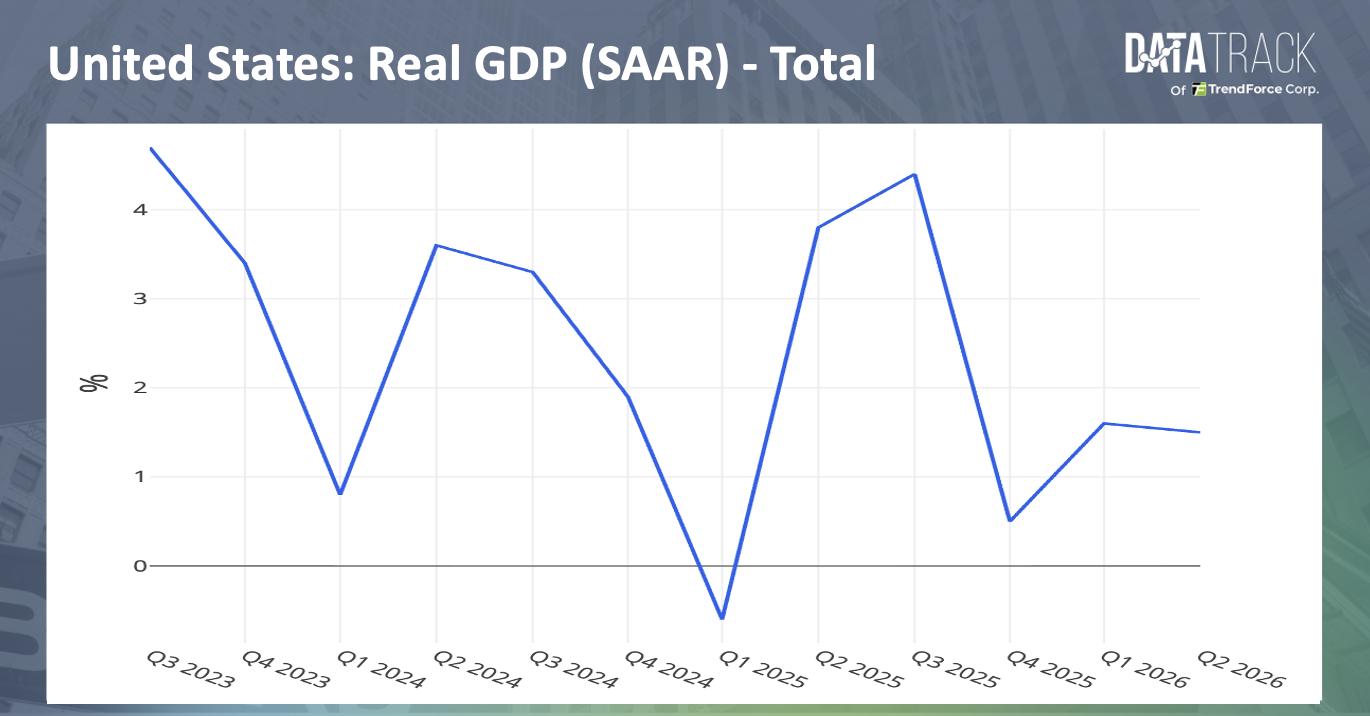
In the second quarter of 2026, the U.S. and euro area economies moved in different directions. U.S. real gross domestic product (GDP) growth slowed from an annualized quarter-on-quarter rate of 2.1% in the first quarter to 1.5%, below market expectations. Euro area GDP, meanwhile, shifted from no growth in the first quarter to a quarterly increase of 0.4%, while its year-on-year growth rate also rose to 1.0%. Because the United States reports an annualized quarterly growth rate while the euro area uses a non-annualized quarterly rate, the two figures cannot be compared directly. On a comparable basis, U.S. GDP also grew by approximately 0.4% in the second quarter, indicating that growth rates on the two sides of the Atlantic have moved significantly closer.
However, the convergence in growth rates does not mean that the United States and the euro area have entered the same stage of the economic cycle. The United States is slowing from a relatively high growth level, mainly because of lower government spending and a drag from net exports. The euro area, by contrast, is recovering from stagnation, with its major economies all maintaining positive growth. The current pattern is better described as the United States cooling from a high level while the euro area stabilizes from a low base, with clear differences remaining in the foundations of their respective recoveries.
| Indicator |
United States |
Euro Area |
| Initial estimate of real GDP in the second quarter of 2026 |
Annualized quarterly growth of 1.5%, equivalent to quarterly growth of approximately 0.4% |
Quarterly growth of 0.4% |
| July manufacturing PMI final reading |
53.9 |
51.9 |
| Latest core inflation |
Core PCE inflation rose 3.3% year on year in June 2026 |
Core HICP inflation rose 2.5% year on year in the July 2026 preliminary estimate |
| Latest policy rate |
Federal funds rate of 3.50%–3.75% |
Deposit facility rate of 2.25% |
Note 1: The initial estimates of second-quarter 2026 GDP for both the United States and the euro area were released on July 30, 2026. The United States uses a seasonally adjusted annualized quarterly growth rate, while the euro area uses a non-annualized quarterly growth rate. The U.S. annualized quarterly growth rate of 1.5% in the second quarter is equivalent to a non-annualized quarterly increase of approximately 0.4%.
Note 2: The U.S. inflation data refer to the June 2026 PCE price index, while the euro area data refer to the preliminary July 2026 HICP estimate. The reference months, statistical indicators, and release stages differ, so the figures are mainly used to observe the latest inflation trend in each economy and should not be used to compare inflation levels directly.
Data are current as of August 3, 2026.
U.S. GDP Growth Slows, but Private Demand Has Not Yet Lost Significant Momentum
U.S. GDP growth slowed to an annualized quarterly rate of 1.5% in the second quarter, mainly reflecting a shift in government spending from growth to contraction, slower investment and export growth, and a larger increase in imports than in the first quarter. Because imports are deducted in the calculation of GDP, net exports became a significant drag on overall growth. Consumption, private investment, and exports themselves nevertheless continued to make positive contributions to GDP, meaning that the slowdown in headline growth should not be interpreted directly as a rapid deterioration in domestic demand.
After excluding more volatile components such as government spending, inventories, and net exports, real final sales to private domestic purchasers, which consist of personal consumption and private fixed investment, increased at an annualized quarterly rate of 3.9% in the second quarter, up from 1.7% in the first quarter. Business investment was supported primarily by industrial equipment, transportation equipment, information-processing equipment, software, and research and development. Growth in information technology and intellectual property products was consistent with continued expansion in AI infrastructure and corporate digitalization investment, suggesting that the U.S. economy is currently experiencing a reconcentration of its sources of growth.
Household consumption remains resilient, but financial buffers are shrinking. Nominal personal consumption expenditures increased by 0.3% month on month in June, while real consumption rose by 0.4%. Personal income and disposable personal income both increased by only 0.2%, pushing the personal saving rate down to 2.7%. Households are still maintaining spending, but continued consumption growth above income growth means that spending momentum could become more vulnerable if employment conditions weaken or energy prices rise again.
The Euro Area Recovers from Stagnation, with Manufacturing Emerging as a Sign of Improvement
Euro area GDP increased by 0.4% in the second quarter, improving from zero growth in the first quarter. The European Union as a whole expanded by 0.5%. Ireland and several smaller and medium-sized economies recorded faster growth, Spain maintained relatively strong momentum, and Germany, France, and Italy also avoided quarterly contractions. Although the initial estimates may still be revised, the second-quarter results suggest that the European economy displayed greater short-term resilience than initially expected despite elevated energy prices and continued uncertainty surrounding the situation in the Middle East.
Manufacturing also showed clearer signs of stabilization. The euro area manufacturing PMI rose from 51.4 in June to 51.9 in July, while the manufacturing output index increased from 51.7 to 52.9, its highest level since March 2022. Germany improved and Italy remained in expansion, while France and Spain were broadly stagnant, showing that substantial differences remained within the region.
The recovery in production still carries risks. New orders increased only slightly in July, and companies raised output mainly by working through previously accumulated backlogs. Employment and purchases of raw materials continued to decline. If new orders fail to take over as a source of growth, manufacturing momentum could weaken again once outstanding work has been completed. The euro area has therefore shown signs of stabilization, but has not yet achieved a full recovery supported by broadly expanding demand.
The final U.S. Markit manufacturing PMI reading for July was 53.9, still above the euro area’s final July Markit manufacturing PMI reading of 51.9. However, U.S. manufacturing output growth slowed to a four-month low, new-order growth decelerated for a third consecutive month, and business confidence fell to a nine-month low. This indicates that the narrowing gap between the two manufacturing sectors reflects both improvement in Europe and weakening marginal momentum in the United States.
Latest Inflation Trends Diverge as U.S. Inflation Eases in June and Euro Area Inflation Edges Higher in July
Because the latest available data refer to different months, the following discussion examines U.S. inflation in June and euro area inflation in July separately. The overall U.S. PCE price index declined by 0.1% month on month in June, while the core PCE index increased by 0.1%. Their year-on-year growth rates slowed from 4.1% and 3.4% in the previous month to 3.7% and 3.3%, respectively. The easing in inflation was driven mainly by lower energy prices, while underlying price pressures remained above the Federal Reserve’s 2% target. The improvement in a single month is therefore insufficient to confirm that inflation has returned sustainably to target.
The euro area’s latest figures are the preliminary estimates for July. Headline HICP inflation increased from 2.8% in June to 2.9%, while core inflation rose from 2.4% to 2.5%. Energy-price inflation accelerated from 8.5% to 10.0%, and services inflation also increased to 3.3%. The European Central Bank therefore needs to continue monitoring whether the energy shock spreads further to wages, services, and other goods prices.
Growth Rates Are Converging, but the Fed and ECB Still Face Different Policy Considerations
At its July meeting, the Federal Reserve maintained the federal funds rate target range at 3.50%–3.75%. The decision passed by a vote of nine to three, with three members favoring a 25-basis-point increase. This shows that even as GDP growth and monthly inflation eased, Federal Reserve officials remained divided over whether the current interest-rate level was sufficient to contain inflation.
The European Central Bank also left interest rates unchanged, keeping its deposit facility rate at 2.25%. However, it did not pre-commit to its next policy move and maintained a meeting-by-meeting, data-dependent approach. Compared with the still-resilient private demand in the United States, the euro area has a weaker recovery base but is more exposed to imported energy prices. The ECB must therefore assess both the economic recovery and the risk of second-round inflation effects.
U.S. Consumption and European New Orders Will Be Critical in the Second Half of the Year
Looking ahead to the second half of the year, U.S. GDP growth may struggle to return rapidly to its previous highs if lower government spending, the drag from net exports, and slower income growth persist. Consumption and investment in equipment, software, and research and development can nevertheless continue to provide support. The main risk is that the saving rate is already low, meaning that a further deterioration in the labor market could lead household consumption to slow.
The euro area, meanwhile, needs to transform the current rebound, which has been driven by improving confidence, the completion of backlogged orders, and domestic demand in several countries, into more sustained growth in new orders, business investment, and household consumption. If energy prices remain elevated, they will simultaneously squeeze real household income, corporate profits, and the room available for monetary policy.
The convergence in U.S. and euro area momentum therefore more closely resembles the intersection of two different economic trajectories. The United States still has support from private demand, but its growth rate has slowed from a high level. The euro area has moved out of stagnation, but must still demonstrate that its recovery can spread from production to new orders and domestic demand. Whether these two conditions are met will determine whether the narrowing growth gap across the Atlantic proves temporary or develops into a more durable economic rebalancing.