At the San Francisco AI Summit held on July 24, 2026, the South Korean government announced semiconductor cooperation worth a combined US$950 billion between Korean companies and global technology firms. SK Group will establish five-year advanced memory supply partnerships with NVIDIA and other companies, while Samsung Electronics will expand its cooperation with Broadcom across memory, AI chip foundry services, and advanced packaging.
The significance of the initiative extends beyond its headline value. As high-bandwidth memory (HBM), server DRAM, and advanced packaging become key constraints on AI infrastructure expansion, major technology companies are moving to secure memory capacity several years in advance. Memory procurement is consequently shifting more rapidly from quarterly negotiations toward multi-year long-term supply agreements.
US0 Billion Consists of Two Five-Year Partnerships Led by SK and Samsung
According to the South Korean government, SK Group will pursue approximately US$750 billion in five-year advanced memory supply cooperation with NVIDIA and other global technology companies. Samsung Electronics, meanwhile, has signed a five-year memorandum of understanding with Broadcom covering more than US$200 billion in cooperation. Together, the two arrangements make up the announced US$950 billion semiconductor cooperation package.
| Cooperation |
Value and Duration |
Main Scope |
| SK Group and global technology companies |
Approximately US$750 billion over five years |
Long-term supply of advanced memory, including more than US$500 billion in cooperation between SK and NVIDIA |
| Samsung Electronics and Broadcom |
More than US$200 billion over five years |
Advanced memory including HBM, AI chip foundry services, and advanced packaging |
The cooperation between SK and NVIDIA, valued at more than US$500 billion, covers next-generation memory and AI data centers. SK hynix will jointly develop memory solutions including HBM, while SK Telecom plans to build AI data centers with capacity of up to 2GW using NVIDIA’s Vera Rubin platform and SK hynix HBM4. The first facility is expected to begin operations in 2027.
Samsung’s cooperation with Broadcom covers HBM, sub-2nm foundry manufacturing, and 2.3D and 2.5D advanced packaging. This reflects growing demand among AI chip customers for tighter integration across memory, logic semiconductors, and packaging. SK is pursuing a model that combines memory supply with data center infrastructure, while Samsung is seeking customers through its integrated memory, foundry, and packaging capabilities.
The summit also announced AI data center cooperation with total capacity of approximately 5GW. Based on NVIDIA B200-equivalent computing capacity, this would correspond to roughly two million GPUs. This infrastructure initiative is separate from the US$950 billion semiconductor cooperation package.
In addition, South Korea’s Ministry of Science and ICT signed a memorandum of understanding with AMD in San Francisco on July 23. The two sides will jointly build and validate AI computing infrastructure combining AMD CPUs and GPUs with Korean-developed neural processing units (NPUs). The cooperation indicates that South Korea is also seeking to integrate domestic NPUs with global CPU and GPU platforms while expanding its broader AI computing ecosystem.
US0 Billion Does Not Represent Immediate Investment or Guaranteed Revenue
The US$950 billion package covers memory supply, foundry manufacturing, advanced packaging, and joint development arrangements. The full amount will therefore not immediately become revenue for Samsung Electronics or SK hynix following the signing of the agreements.
The more than US$500 billion in cooperation between SK and NVIDIA involves both memory and AI data centers, while Samsung’s US$200 billion arrangement with Broadcom is based on a memorandum of understanding. The amount ultimately realized will depend on procurement volumes, product pricing, customer qualification, and mass-production progress. The US$950 billion figure is therefore better understood as a five-year cooperation framework that improves visibility into future demand.
Longer AI Platform Development Cycles and HBM Supply Constraints Drive Long-Term Agreements
Traditional memory procurement is highly sensitive to quarterly contract prices, spot prices, and inventory cycles. AI data centers, however, operate on longer procurement timelines. GPUs and custom AI accelerators often require several years of design and validation, while HBM must be co-developed, integrated into advanced packaging, and qualified for mass production alongside computing chips.
Major technology companies are therefore negotiating specifications and supply volumes for several future product generations in advance. A number of US cloud service providers have already signed multi-year long-term agreements (LTAs) with memory manufacturers. Large customers can use purchase commitments to secure capacity and relatively stable pricing, while suppliers can plan process transitions, equipment investment, and product development with greater confidence. Customers without long-term agreements, or those seeking additional supply beyond existing contracts, may face higher prices and longer lead times.
HBM uses larger dies, more stacked layers, and more complex packaging processes than conventional DRAM, resulting in higher wafer-capacity consumption per bit. As suppliers allocate more capacity to HBM, the wafer resources available for server RDIMMs, PC DRAM, and mobile memory are also constrained. New-generation AI platforms are simultaneously increasing the memory capacity installed in each accelerator, making it difficult for overall bit supply growth to keep pace with demand.
According to the latest TrendForce research, server DRAM contract prices are projected to rise by 13%–18% quarter over quarter in the third quarter of 2026. RDIMM bit supply is expected to increase by only approximately 15%–20% in 2027, potentially lagging growth in server CPU shipments. Server DRAM contract prices may continue rising sequentially through the second half of 2027, although the pace of increase is expected to moderate.
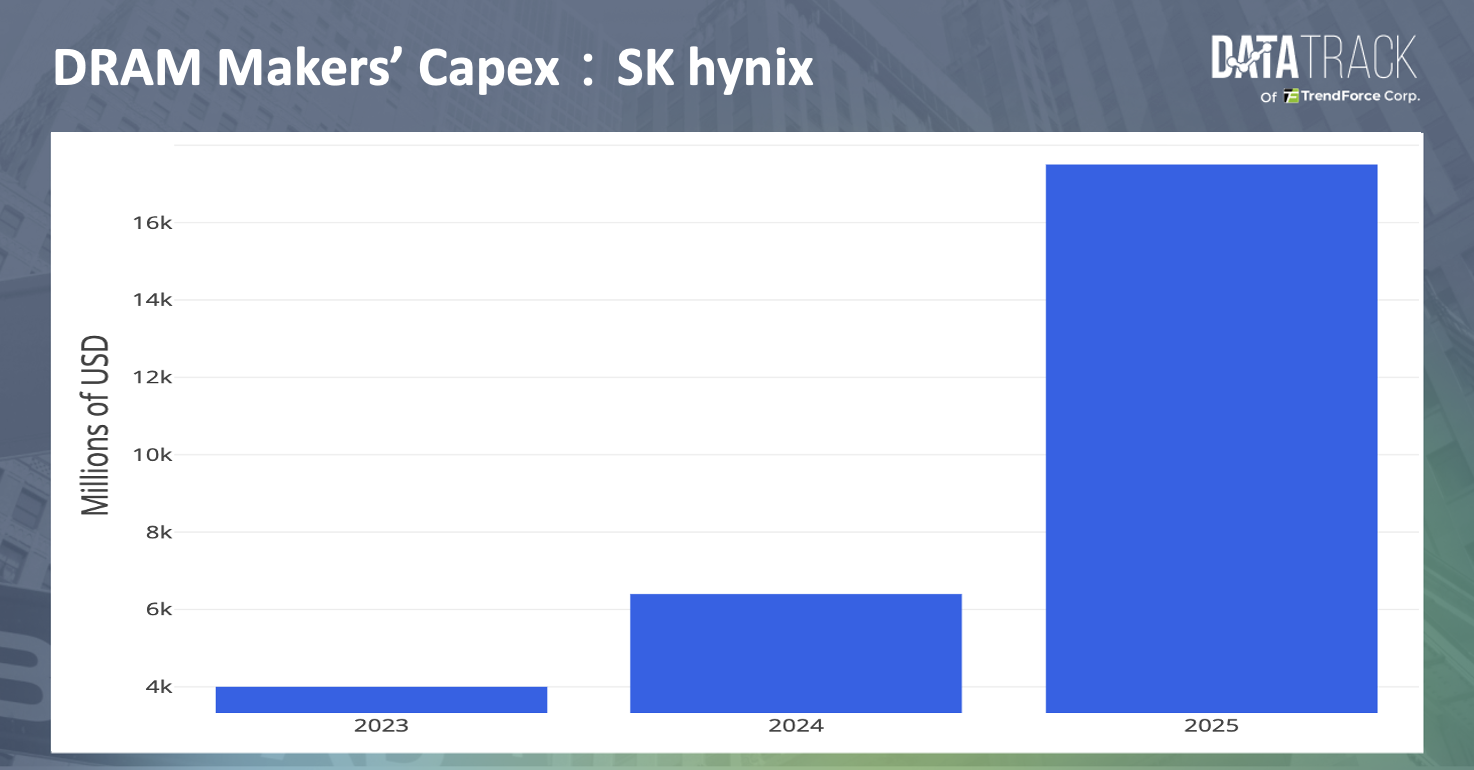
Suppliers are responding to demand for AI and high-end memory by expanding capital expenditure. SK hynix’s DRAM capital expenditure has increased significantly in recent years, indicating greater investment in memory capacity and process upgrades. However, higher capital expenditure does not immediately translate into marketable bit supply. Equipment installation, process migration, product qualification, and yield improvement all take time, making it difficult to fully alleviate HBM and server DRAM supply pressure in the near term.
DRAM and NAND Flash Supply-Demand Conditions May Diverge in the Second Half of 2027
The effects of long-term supply agreements are not uniform across memory products. The latest NAND Flash research indicates that the NAND Flash supply-demand bit gap is expected to remain at approximately negative 4%–5% in 2026, meaning the market will remain undersupplied.
However, process upgrades, the addition of new capacity, and weak smartphone and notebook demand could push the NAND Flash supply-demand gap into positive territory in the second half of 2027. By comparison, HBM and server DRAM remain constrained by wafer and advanced packaging capacity, meaning supply pressure may persist for longer and long-term agreements could provide stronger support for both availability and pricing.
Long-Term Agreements Improve Visibility, but Execution Still Depends on Demand and Infrastructure
Long-term supply agreements help memory manufacturers plan capacity and investment, but they may also increase customer and capacity concentration risks. If more advanced capacity is allocated in advance to a small number of major AI customers, smaller server companies and consumer electronics manufacturers may face greater difficulty obtaining supply. If AI capital expenditure falls below expectations, procurement volumes, pricing, and delivery schedules could also be renegotiated.
The realization of these agreements will depend on customer qualification and production yields for HBM4, sub-2nm processes, and advanced packaging, as well as the availability of electricity, land, cooling systems, network infrastructure, and financing for AI data centers.
South Korea’s newly announced cooperation shows that competition in the global memory industry is shifting toward multi-year capacity and technology partnerships. In addition to spot and quarterly contract prices, future assessments of the memory market will need to monitor HBM capacity allocation, LTA coverage, AI customer capital expenditure, and the pace at which new supply enters the market.