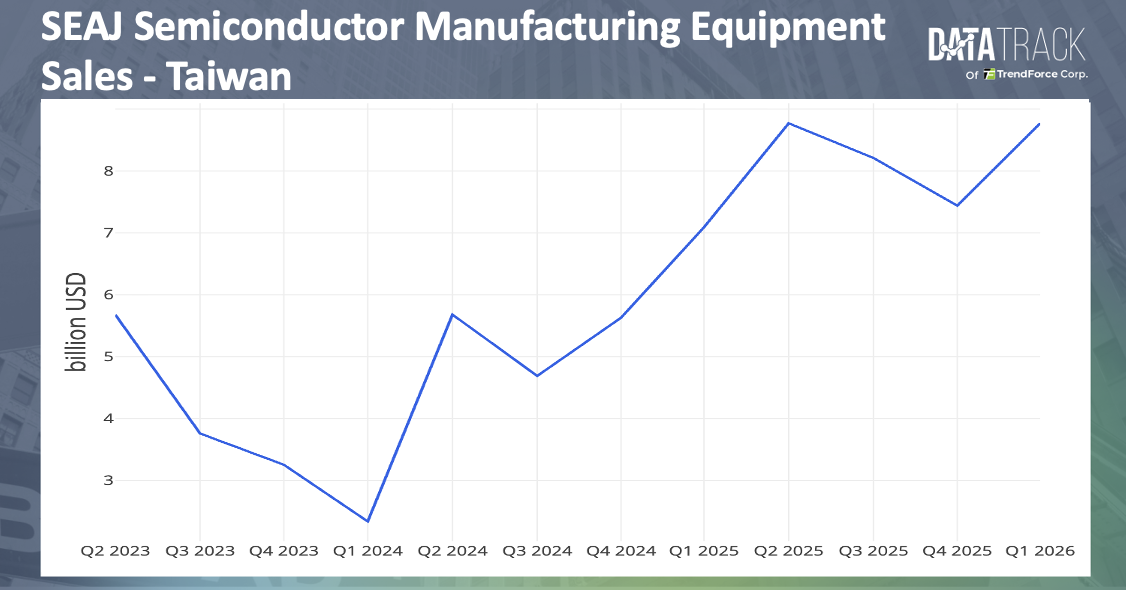
AI investment is rapidly reshaping Taiwan’s electricity demand structure. In June 2026, the Ministry of Economic Affairs released the latest National Electricity Supply and Demand Report, raising its forecast for average annual electricity demand growth from 1.7% to 2.5% for 2026–2035, the second-highest projection on record. An internal assessment by Taiwan Power Company, or Taipower, also indicates that electricity consumption by the semiconductor industry could increase from approximately 52 billion kWh in 2026 to 110 billion kWh in 2035, while its share of Taiwan’s total electricity consumption could rise from 17% to 30%. In ten years, nearly one out of every three kWh consumed in Taiwan could be used for semiconductor manufacturing.
This demand is being driven simultaneously by advanced logic processes, high-bandwidth memory (HBM), advanced packaging, and AI data centers (AIDCs). As manufacturing processes become more complex, more production equipment, cleanrooms, cooling systems, and facility systems are required to operate. AIDCs also have relatively high load factors and backup power requirements, further concentrating electricity demand in specific areas. The Ministry of Economic Affairs has identified approximately 1.1–1.2 GW of AIDC electricity applications through 2035, while the power system has retained additional supply headroom capable of accommodating approximately 2–3 GW of new applications.
| Key Indicator |
Latest Data |
Statistical Scope |
| Average annual growth rate of nationwide electricity demand |
Approximately 2.5% |
Ministry of Economic Affairs forecast for 2026–2035 |
| Semiconductor industry electricity consumption |
Approximately 52 billion kWh in 2026 and 110 billion kWh in 2035 |
Taipower internal assessment |
| Semiconductor industry’s share of nationwide electricity consumption |
Approximately 17% in 2026, 24% in 2030, and 30% in 2035 |
Taipower internal assessment |
| AIDC electricity applications |
Approximately 1.1–1.2 GW through 2035 |
Identified and projected application capacity |
| AIDC power supply planning headroom |
Approximately 2–3 GW |
System headroom available to accommodate subsequent applications |
| Planned additions of gas-fired generating units |
Approximately 26 GW in cumulative additions from 2026 to 2035 |
Combined plans by Taipower and private power producers, rather than a net capacity increase |
Industrial Expansion Is Outpacing Power Infrastructure Development
Although Taiwan’s total electricity consumption declined slightly in 2025 from the previous year, production cuts in traditional industries and energy-saving measures masked growth in electricity demand from the semiconductor and information and communications technology industries. As incremental electricity demand becomes increasingly concentrated in wafer fabs, advanced packaging facilities, and data centers, power supply pressure will also become more differentiated across industries and regions.
The greatest challenge lies in the timing gap between industrial construction and power supply development. Semiconductor plants and other electronics factories can usually complete construction or expansion within two to three years, while some companies can move even faster by converting existing facilities. The construction cycle for data centers is also generally shorter than that of large power plants. By contrast, large power plants involve land acquisition, environmental impact assessments, local engagement, and lengthy construction, with development periods frequently exceeding ten years. Transmission and substation projects may also be constrained by land acquisition, local coordination, and construction progress, causing new loads to emerge before the required power supply capacity is fully in place.
To address long-term demand, the Ministry of Economic Affairs plans to add approximately 26 GW of gas-fired generating units on a cumulative basis between 2026 and 2035, covering Taichung, Hsinta, Tung Hsiao, Talin, Hsieh-ho, and several private power plants. However, additional generating capacity must still be supported by transmission lines, substations, energy storage, and backup systems. As solar power increases daytime supply capacity, pressure on the system is gradually shifting toward evening peak periods, requiring coordinated dispatch among gas-fired generation, hydropower, and energy storage. AI data centers and semiconductor plants also require stable voltage and uninterrupted power supply. Even when sufficient supply headroom exists nationwide, individual projects may still face connection delays and site-selection constraints if specific science parks or metropolitan areas lack adequate substation capacity.
Electricity Rate Freezes Ease Inflation Pressure but Shift Costs onto Taipower’s Balance Sheet
In March 2026, the Electricity Tariff Review Committee decided to maintain the average electricity rate at NT$3.7823 per kWh after considering energy prices, consumer inflation, and industrial competitiveness. Freezing electricity rates can slow the transmission of energy costs to consumer prices and corporate expenses, but it also makes it more difficult for fuel, grid, and incremental capacity costs to be reflected promptly in end-user prices.
As of the end of May 2026, Taipower’s accumulated losses still reached NT$367.2 billion, with liabilities of approximately NT$2.78 trillion and a debt ratio of 91.6%. Taipower will still need to invest in power plants, transmission and substation facilities, and energy storage. If electricity rates continue to lag behind actual costs, the funding gap will still have to be covered through borrowing, government capital injections, or budgetary support. However, an across-the-board increase in industrial electricity rates may not address the problem precisely. During the September 2025 electricity rate review, the Ministry of Economic Affairs stated that industrial electricity rates at the time had already broadly reflected costs.
As AI and semiconductor electricity demand continues to rise, the key issue is how the incremental cost of electricity should be priced and allocated. The establishment of a large wafer fab or data center may require dedicated substations, reinforced transmission infrastructure, backup capacity, and higher-cost stable power supply during nighttime hours. If these expenditures are distributed evenly across all users, the existing rate structure will struggle to reflect differences in electricity consumption time, location, and reliability requirements.
Electricity Rate Reform Will Place Greater Emphasis on Large Users and System Cost Allocation
Future electricity rate reform may rely more heavily on existing time-of-use pricing, contracted capacity charges, and demand response mechanisms, while further differentiating grid connection costs, peak load responsibilities, and backup obligations. Large users may also reduce peak loads and system costs by adjusting production schedules, installing energy storage systems, and participating in demand response programs.
Proposed amendments to the Energy Administration Act are moving in the same direction. During its review of the bill on July 22, 2026, the Legislative Yuan’s Economics Committee discussed an initial threshold of 5 MW in contracted capacity, under which energy users above a certain scale would be required to install self-generation and energy storage equipment. The Ministry of Economic Affairs stated that more than 700 companies in Taiwan have contracted capacities of at least 5 MW, covering industries including semiconductors, petrochemicals, steel, photovoltaics, and AI data centers. However, the actual number of regulated companies will depend on the final threshold, installation ratio, exemption rules, and implementing regulations.
The final threshold, installation requirements, and transition arrangements remain subject to legislative approval and implementing rules. The Ministry of Economic Affairs stated that it would consider the constraints faced by urban factories, older industrial parks, and different industrial sites, with a transition period of approximately five years as the preliminary benchmark. Self-generation and energy storage cannot fully replace Taipower’s supply, but they can help reduce peak demand, provide emergency backup, and allow large users to assume part of the responsibility for maintaining grid stability.
Rising Electricity Rates Will Deepen the Divide Between Technology and Traditional Industries
Semiconductor companies and most technology firms generally have stronger profitability and greater capacity to absorb higher electricity prices. Petrochemicals, textiles and fibers, steel, and retail face higher energy intensity, lower profit margins, and cyclical downturns, making cost increases more likely to directly erode earnings.
Fitch Ratings stated in July 2026 that Taiwan’s energy prices had not yet fully reflected high energy costs. If electricity rates were raised by 10%, operating losses in the petrochemical and textile and fiber industries could widen further, while semiconductor companies and most technology firms would have relatively stronger capacity to absorb the increase. Electricity policy therefore needs to address both Taipower’s financial position and differences across industries. Keeping prices suppressed may weaken incentives for energy conservation and limit grid investment, while a rapid across-the-board increase could deepen the divergence in industrial profitability. A more feasible approach would be to allow prices to gradually reflect power supply costs while providing energy-efficiency financing, process improvements, and time-limited transition support to help low-margin industries reduce their energy intensity.
The AI Electricity Boom Will Redefine Taiwan’s Power Policy
Taiwan’s next-stage electricity challenge has expanded beyond adding generating capacity to whether industrial expansion, grid investment, and electricity pricing can be adjusted in step with one another. As semiconductor facilities and AI data centers continue to increase their electricity consumption, policy attention will focus on how the generation, transmission, substation, and backup costs created by large users’ incremental demand should be priced, and whether regional grids can be completed before new facilities begin production.
Key issues to monitor include whether semiconductor electricity consumption grows in line with Taipower’s forecasts, how much of the AIDC application capacity is ultimately developed, whether gas-fired generating units and transmission and substation projects can proceed on schedule, and the final rules requiring large electricity users to install self-generation and energy storage equipment. AI is creating opportunities for exports, investment, and industrial upgrading in Taiwan, while also making stable and affordable electricity an increasingly important condition for corporate investment. The central issue in electricity rate reform will gradually shift toward who should bear the cost of incremental electricity demand and how a more transparent allocation mechanism can be established among energy security, industrial development, and the varying cost-bearing capacities of different industries.