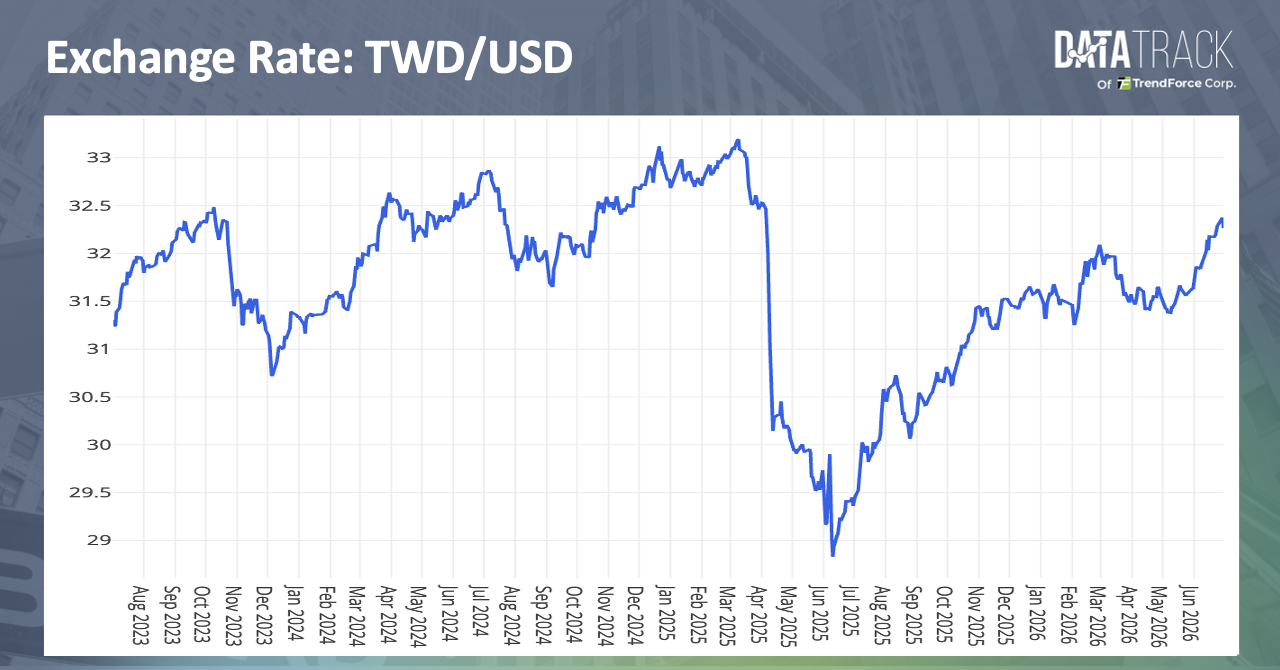
Continued expansion in global artificial intelligence infrastructure investment has driven rapid growth in Taiwan’s exports of semiconductors, servers, and information and communications technology products. The export boom has not only lifted economic growth but also pushed Taiwan’s current account surplus to a historically high level, drawing closer attention to the New Taiwan dollar exchange rate, the central bank’s foreign exchange operations, and life insurers’ hedging policies.
In July 2026, the U.S. Department of the Treasury released its latest Report to Congress on Macroeconomic and Foreign Exchange Policies of Major Trading Partners of the United States. The report stated that Taiwan’s current account surplus as a share of gross domestic product (GDP) rose from 14.1% in 2024 to 19.6% in 2025, while its goods and services trade surplus with the United States nearly doubled to US$145.0 billion. As both Taiwan’s current account surplus and its trade surplus with the United States exceeded the U.S. thresholds, Taiwan remained on the foreign exchange policy Monitoring List. A current account surplus approaching one-fifth of GDP reflects Taiwan’s competitive advantage in the global AI supply chain, but it also indicates rising imbalances among export earnings, capital flows, and exchange rate policy.
AI Demand Drives Rapid Expansion in the Goods Surplus
The current account consists of goods, services, primary income, and secondary income, with trade in goods traditionally serving as the main source of Taiwan’s surplus. The latest revised data from Taiwan’s central bank show that the current account surplus reached US$179.77 billion in 2025, an increase of US$67.06 billion from 2024. The goods surplus rose from US$99.36 billion to US$174.95 billion, an increase of US$75.59 billion, making it the main contributor to the expansion in the current account surplus. The services balance remained in deficit, while primary income continued to record a surplus.
| Indicator |
2024 |
2025 |
| Current account balance |
Surplus of US$112.71 billion |
Surplus of US$179.77 billion |
| Current account surplus as a share of GDP |
14.1% |
Approximately 19.5% |
| Goods balance, balance-of-payments basis |
Surplus of US$99.36 billion |
Surplus of US$174.95 billion |
| Services balance |
Deficit of US$12.20 billion |
Deficit of US$13.58 billion |
| Primary income balance |
Surplus of US$30.27 billion |
Surplus of US$25.91 billion |
| Secondary income balance |
Deficit of US$4.72 billion |
Deficit of US$7.51 billion |
Note: The 2024 and 2025 balance-of-payments figures are based on the latest revisions published by Taiwan’s central bank in May 2026. Based on the data available at the time of writing, the Taiwan section of the U.S. Treasury’s July 2026 foreign exchange report placed Taiwan’s 2025 current account surplus at 19.6% of GDP, while the quantitative assessment table in the same report listed the ratio at 19.5%.
The expansion in the surplus has been highly concentrated by industry. Continued growth in demand for AI, high-performance computing, and advanced process technologies has boosted exports of semiconductors, electronic components, servers, and information and communications equipment. The U.S. Treasury also noted that strong U.S. demand for Taiwanese technology products, together with advance purchases by some importers in anticipation of tariff changes, further widened Taiwan’s surplus with the United States.
Taiwan’s external surplus continued to increase in 2026. In the first quarter of 2026, Taiwan recorded a current account surplus of US$62.53 billion, an increase of US$32.84 billion from the same period a year earlier, including a goods surplus of US$58.01 billion. Goldman Sachs forecasts that if the AI chip export boom continues, Taiwan’s current account surplus could exceed 20% of GDP in 2026.
Domestic economic growth forecasts have also been revised upward. On July 24, the Taiwan Institute of Economic Research raised its forecast for Taiwan’s 2026 economic growth rate to 10.38%, while the Chung-Hua Institution for Economic Research projected growth of 10.35%. This indicates that AI demand has extended from exports into equipment investment, corporate earnings, stock market wealth effects, and part of private consumption.
The Current Account Surplus Creates Appreciation Pressure, but Capital Flows Determine the Actual Exchange Rate
When exporters receive payments in U.S. dollars and repatriate and convert the funds into New Taiwan dollars, the supply of U.S. dollars and demand for New Taiwan dollars in the market increase. Therefore, growth in goods exports and the current account surplus generally creates medium- to long-term appreciation pressure on the New Taiwan dollar. However, a current account surplus does not mean that all foreign exchange earnings will immediately be converted into New Taiwan dollars. Companies may use the funds to establish overseas production facilities, while financial institutions and households may purchase overseas equities, bonds, or other foreign-currency assets, creating financial-account outflows that offset part of the appreciation pressure.
Taiwan’s financial account recorded a net increase in assets of US$154.79 billion in 2025, up from US$93.40 billion in 2024. Within this total, the net increase in direct investment assets rose from approximately US$20.92 billion to US$34.36 billion. Overseas investment by Taiwanese companies, large holdings of foreign assets by life insurers, and overseas financial asset allocation by households all help absorb the foreign exchange surplus generated by the current account. The movement of the New Taiwan dollar therefore depends on the combined effects of exporter conversions, corporate overseas investment, foreign investor flows into and out of Taiwan’s stock market, life insurers’ hedging demand, and central bank operations.
Taiwan Remains on the U.S. Foreign Exchange Monitoring List
The U.S. Treasury mainly uses three quantitative criteria to assess the foreign exchange policies of major trading partners: the bilateral trade surplus with the United States, the current account surplus, and persistent, one-sided intervention in the foreign exchange market.
| U.S. Treasury assessment criterion |
Threshold |
Taiwan’s 2025 performance |
| Goods and services trade surplus with the United States |
At least US$15 billion |
US$145.0 billion |
| Current account surplus as a share of GDP |
At least 3% |
Approximately 19.5% |
| Persistent, one-sided foreign exchange intervention |
Net purchases in at least 8 out of 12 months, with total purchases equal to at least 2% of GDP |
Full-year net purchases equal to 0.8% of GDP, below the threshold |
Taiwan exceeded the first two thresholds, but the central bank’s full-year net foreign exchange purchases totaled US$7.7 billion in 2025, equivalent to 0.8% of GDP, below the U.S. threshold. Taiwan therefore remained on the Monitoring List but was not designated a currency manipulator.
It is worth noting that the full-year figure conceals differences in operations across periods. Taiwan’s central bank purchased US$13.25 billion in foreign exchange during the first half of 2025, equivalent to approximately 3.1% of GDP during the same period, with most purchases concentrated in May when the New Taiwan dollar faced rapid appreciation pressure. Partial foreign exchange sales in other months reduced the full-year net purchase ratio to 0.8%.
The U.S. Treasury also noted that the New Taiwan dollar appreciated by 4.5% against the U.S. dollar in 2025, but some private-sector models based on the current account, purchasing power parity, and the real effective exchange rate still indicated that the currency may be undervalued. As Taiwan’s surplus expands further, U.S. attention to the scale and transparency of Taiwan’s foreign exchange intervention is likely to continue. In November 2025, Taiwan’s central bank and the U.S. Treasury issued a joint statement committing to disclose foreign exchange intervention data at least quarterly, with a one-quarter lag, indicating that exchange rate policy transparency has become an important issue in bilateral discussions.
New Life Insurance Hedging Rules Become a New Exchange Rate Variable
The latest U.S. foreign exchange report included a separate section on Taiwan’s life insurance industry, reflecting the growing importance of insurers’ overseas assets and hedging activity in determining supply and demand for the New Taiwan dollar. As of 2025, Taiwan’s life insurance industry had approximately US$1.2 trillion in assets, equivalent to 131% of GDP. Around 60% was invested in overseas assets, representing more than US$700 billion in foreign asset exposure. Because policy liabilities are primarily denominated in New Taiwan dollars while overseas assets are mostly denominated in U.S. dollars, life insurers need to use forward foreign exchange contracts, currency swaps, and other instruments to manage exchange rate risk.
When life insurers raise their hedge ratios, they generally establish positions that sell U.S. dollars and buy New Taiwan dollars, increasing demand for the local currency. A lower hedge ratio, by contrast, helps reduce appreciation pressure on the New Taiwan dollar. Beginning in late 2025, the Financial Supervisory Commission adjusted related accounting and reserve rules, allowing life insurers to amortize foreign exchange gains and losses on certain foreign bonds over the remaining life of the bonds, reducing the effect of short-term exchange rate fluctuations on current-period earnings. Taiwan’s life insurance hedge ratio had fallen to approximately 45% by February 2026, down from 60% in September 2025 and around 70% before the pandemic.
Lower hedge ratios can reduce high hedging costs and decrease life insurers’ demand to purchase New Taiwan dollars in the foreign exchange market, but insurers must also bear greater exchange rate risk. If the New Taiwan dollar appreciates rapidly, the New Taiwan dollar value of overseas assets may decline, affecting insurers’ net worth and capital adequacy. The Financial Supervisory Commission has stated that the new rules are intended to improve the financial reporting of long-term assets, reduce excessive hedging costs, and strengthen the capital resilience of the life insurance industry. Insurers are required to allocate part of the hedging costs they save to reserves, gradually building a buffer to absorb future foreign exchange losses. From the perspective of the foreign exchange market, lower hedging demand may also reduce demand for the New Taiwan dollar and ease appreciation pressure.
Short-Term New Taiwan Dollar Depreciation Does Not Eliminate Long-Term Policy Pressure
Although the current account surplus continued to expand, the New Taiwan dollar still weakened at one point in July 2026. On July 24, the interbank closing exchange rate was NT$32.358 per U.S. dollar, representing a depreciation of NT$0.092 from the previous trading day. Taiwan’s stock market also fell by more than 1,000 points at one point during the same session. At the time, escalating conflict in the Middle East pushed Brent crude oil futures above US$100 per barrel, intensifying concerns over energy supplies and renewed inflation. The U.S. dollar and U.S. Treasury yields rose simultaneously, while the decline in Taiwanese equities and expectations of foreign capital outflows caused short-term capital flows to temporarily outweigh demand for the New Taiwan dollar generated by exporter conversions.
If high oil prices and New Taiwan dollar depreciation occur simultaneously, they will also raise the local-currency cost of imported energy. The government can delay part of the cost pass-through through CPC Corporation, Taiwan Power Company, and price stabilization mechanisms, but corporate production costs and fiscal burdens may still increase. Inflation forecasts are also approaching levels closely watched by the central bank. The Taiwan Institute of Economic Research forecasts CPI inflation of 1.98% in 2026, while the Chung-Hua Institution for Economic Research projects 2.02%. If tensions in the Middle East persist and increase energy prices and imported inflation, the central bank may face greater pressure to raise interest rates.
However, Taiwan’s economy remains clearly divided across industries. Exports and investment in AI and semiconductors are growing rapidly, while traditional industries face weak demand, exchange rate pressures, and higher costs. If the central bank raises interest rates and this leads to New Taiwan dollar appreciation, or if it directly allows the exchange rate to reflect surplus-related pressures more visibly, it could help contain imported inflation but may further weaken the competitiveness of traditional exporters and increase foreign exchange and valuation pressure on life insurers’ overseas assets.
AI Gains Are Turning into Exchange Rate and Financial Policy Challenges
Taiwan’s current account surplus has approached 20% of GDP, reflecting the large volume of foreign exchange earnings generated by AI and semiconductor exports. The key factor for the subsequent exchange rate trend is whether these funds are repatriated and converted by exporters or redirected into overseas investments and foreign-currency assets. In addition to monitoring whether Taiwan’s current account surplus exceeds 20% of GDP in 2026, it will also be necessary to examine the actual destination of export earnings and the ability of life insurers’ capital to withstand exchange rate movements after reducing hedging.
AI exports remain a major pillar of Taiwan’s economic growth, but their effects have extended to exchange rates, inflation, and financial regulation. As the external surplus grows, the central bank and the Financial Supervisory Commission will increasingly need to balance appreciation pressure on the New Taiwan dollar, imported inflation, the competitiveness of traditional industries, and foreign exchange risk in the life insurance sector.