Brazil’s fiscal pressure intensified further in the first half of 2026. The latest data from the Central Bank of Brazil show that the consolidated public sector recorded a nominal fiscal deficit of BRL 1.318 trillion in the 12 months through June, equivalent to 9.99% of gross domestic product (GDP). This was higher than 9.62% in the 12 months through May and represented a significant increase from 7.3% in June 2025. It was the highest level since April 2021 and was approaching the double-digit deficits recorded during the COVID-19 pandemic, when emergency spending surged.
However, a deficit approaching 10% of GDP does not mean that the Brazilian government spent an amount equivalent to 10% of GDP more than it collected during the period. The nominal deficit comprises the primary balance before interest payments and the nominal interest accrued on government debt. In the 12 months through June, interest payments amounted to 8.80% of GDP, while the primary deficit accounted for only 1.19%. This means that approximately 88% of the nominal deficit came from interest costs. Brazil’s most pressing fiscal problem is therefore the financing burden generated by a large debt stock in a high-interest-rate environment.
Nearly 90% of the Nominal Deficit Comes From Interest, so the Fiscal Shortfall Cannot Be Attributed Entirely to New Spending
The consolidated public sector measured by the Central Bank of Brazil includes the central government, state and local governments, and state-owned enterprises. In the 12 months through June 2026, the consolidated public sector recorded a primary deficit of BRL 157.2 billion, equivalent to 1.19% of GDP. Accrued nominal interest reached BRL 1.161 trillion, or 8.80% of GDP, bringing the nominal deficit to BRL 1.318 trillion.
| Fiscal Indicator |
Latest Data |
Significance |
| Nominal deficit over the past 12 months |
BRL 1.318 trillion, or 9.99% of GDP |
Includes the primary balance and debt interest |
| Primary deficit over the past 12 months |
BRL 157.2 billion, or 1.19% of GDP |
Reflects the government balance before interest payments |
| Accrued nominal interest over the past 12 months |
BRL 1.161 trillion, or 8.80% of GDP |
The main component of the nominal deficit |
| Nominal deficit in June 2026 |
BRL 166.0 billion |
Combined primary deficit and interest payments |
| General government gross debt in June 2026 |
BRL 10.8 trillion, or 81.9% of GDP |
An important measure of the government’s overall debt burden |
| Public sector net debt in June 2026 |
BRL 9.0 trillion, or 68.5% of GDP |
Public debt after deducting certain public-sector assets |
Note: The deficit figures above use the Central Bank of Brazil’s consolidated public-sector “below-the-line” methodology. Under the Brazilian National Treasury’s “above-the-line” methodology, the central government recorded a primary deficit of BRL 48.2 billion in June. The Central Bank’s consolidated public-sector primary deficit was BRL 55.3 billion. The two figures differ in both coverage and statistical methodology and therefore should not be compared simply by calculating the difference between them.
In June alone, accrued nominal interest for the consolidated public sector reached BRL 110.7 billion, rising sharply from BRL 61.0 billion in the same month of 2025. The primary deficit was BRL 55.3 billion, bringing the monthly nominal deficit to BRL 166.0 billion. In addition to interest rates remaining elevated, the Central Bank’s foreign exchange swap operations shifted from a gain of BRL 20.9 billion in June 2025 to a loss of BRL 9.3 billion in June 2026, further increasing interest expenses for the month.
The Debt Structure Allows Policy Rates to Pass Quickly Into Government Financing Costs
The Central Bank of Brazil began cutting interest rates in March 2026 and delivered its fourth consecutive reduction of 0.25 percentage points on August 5, lowering the Selic benchmark rate from 14.25% to 14.00%. However, 14.00% remains a high interest-rate level, and reductions in the policy rate will not be reflected immediately or proportionately in total interest expenses because the repricing and refinancing of government debt occur with a time lag.
The fiscal impact of high interest rates is closely related to the structure of Brazil’s federal public debt. As of June, federal public debt totaled BRL 9.268 trillion. Floating-rate instruments, which mainly move with the Selic rate, accounted for 49.32% of the total. Another 25.90% was linked to price indexes, while fixed-rate securities represented 21.04%. When interest rates and inflation remain elevated, the interest costs of the government’s existing debt also increase.
In addition, approximately 20.1% of federal public debt will mature within the next 12 months, corresponding to repayment needs of around BRL 1.86 trillion. Among domestic federal government securities maturing within one year, floating-rate securities account for 40.4%. The government can use its liquidity reserves to repay part of the debt or issue new securities to refinance it. If new debt must continue to offer high yields, the elevated cost of funding will gradually be transmitted to the overall debt stock.
This pressure is already reflected in debt-cost data published by the National Treasury. In the 12 months through June, the average cost of federal public debt rose from 12.31% in May to 12.68%, while the average cost of the outstanding stock of domestic federal government securities increased from 13.09% to 13.19%. Over the same period, the average cost of domestic federal government securities issued through public offerings was 14.20%, higher than the cost of the existing domestic debt stock. This indicates that new financing could continue to push up the government’s overall interest burden for some time.
Interest Accumulation Is Outpacing the Diluting Effect of Economic Growth on the Debt Ratio
Brazil’s general government gross debt rose to BRL 10.8 trillion in June, equivalent to 81.9% of GDP, an increase of 0.9 percentage points from May. Accrued interest raised the debt ratio by 0.8 percentage points during the month, while net debt issuance added another 0.6 percentage points. Nominal GDP growth reduced the ratio by 0.5 percentage points, but this was insufficient to offset the first two factors.
Over the first six months of 2026, the general government gross debt-to-GDP ratio increased by a cumulative 3.3 percentage points. Accrued interest raised the ratio by 4.9 percentage points, while net debt issuance added 1.3 percentage points. Nominal GDP growth reduced it by 2.7 percentage points, and exchange-rate movements also provided a small offset. Nevertheless, the overall debt burden continued to increase. This shows that while economic growth can expand the denominator of the debt-to-GDP ratio, it has not been sufficient to keep pace with interest accumulation and new debt issuance.
Federal public debt and general government gross debt are not the same indicator. Federal public debt mainly reflects the Brazilian National Treasury’s domestic and external market debt and totaled BRL 9.268 trillion in June. General government gross debt covers the federal government, the social security system, and state and local governments and totaled BRL 10.8 trillion. Both indicators show that debt continues to increase, but they have different coverage and should not be used interchangeably.
Fiscal Concerns, Risk Premiums, and High Interest Rates Form a Self-Reinforcing Mechanism
Brazil’s current fiscal difficulties are the result of interactions among fiscal policy, financial markets, and monetary policy. When government spending increases, the primary deficit persists, or the credibility of fiscal targets weakens, investors may become concerned that public debt cannot be stabilized over the medium term and consequently demand higher government bond yields. A rising fiscal risk premium may also put depreciation pressure on the Brazilian real, increasing import costs and inflation expectations.
When inflation expectations remain elevated, the Central Bank has less room to cut interest rates quickly. A high Selic rate and elevated market yields then increase the cost of floating-rate debt and raise the price of issuing new securities and refinancing maturing debt, causing the nominal deficit and debt stock to continue increasing. The rise in debt subsequently reinforces market concerns about the fiscal outlook, creating a self-reinforcing cycle of rising fiscal risk, persistently high interest rates, increasing interest expenses, and continued debt accumulation.
The Central Bank of Brazil has also repeatedly emphasized in its monetary policy communications that fiscal policy affects not only aggregate demand in the short term but also the term premium along the yield curve through expectations concerning debt sustainability. If fiscal discipline weakens, directed credit expands, or doubts emerge about debt stabilization, the economy’s neutral interest rate could rise, reducing the effectiveness of monetary policy in controlling inflation.
The Economy Remains Resilient, but Growth Cannot Replace Fiscal Adjustment
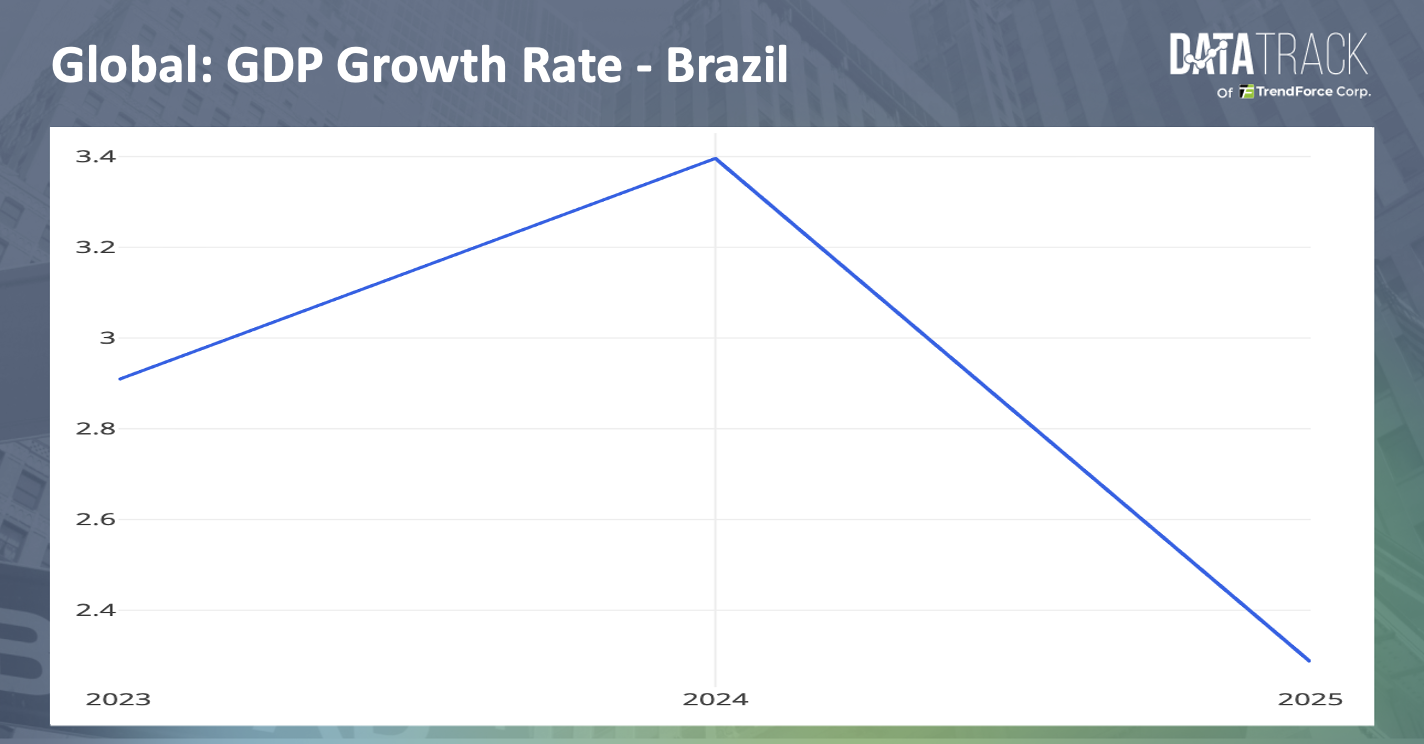
Brazil’s GDP grew by a seasonally adjusted 1.1% quarter over quarter and 1.8% year over year in the first quarter of 2026, reaching BRL 3.3 trillion. Agriculture expanded by 2.0% from the previous quarter, while industry and services grew by 1.0% and 0.5%, respectively. Household consumption and gross fixed capital formation increased by 1.0% and 3.5%. In July, Brazil’s Ministry of Finance maintained its forecast for full-year GDP growth in 2026 at 2.3%.
Economic growth helps increase tax revenue and nominal GDP, reducing the debt-to-GDP ratio, but it cannot automatically resolve fiscal problems. When the effective interest rate on government debt exceeds nominal GDP growth and the primary balance does not generate a surplus sufficient to offset part of the interest burden, the debt ratio will remain under upward pressure.
Brazil’s Ministry of Finance also raised its 2026 forecast for the Broad National Consumer Price Index (IPCA) from 4.5% to 5.1%. The elevated inflation forecast means that even though the Central Bank has begun cutting rates, it will be difficult to return the policy rate rapidly to a lower level. If the government further expands subsidies, preferential financing, or tax cuts to support the economy, these measures may ease the impact of high interest rates on companies and households in the short term. However, they could also increase demand, slow fiscal consolidation, and constrain the scope for additional rate cuts.
Improvement in the Primary Balance Will Determine When the Debt Cycle Can Reverse
The Central Bank’s further rate cut in August will gradually reduce the cost of floating-rate debt and new financing, but debt repricing takes time, meaning that the government’s average financing costs could remain elevated in the near term. The key question is whether the primary balance can improve and whether the government can reduce the risk premium demanded by markets by controlling expenditure growth and improving the credibility of its fiscal targets.
If fiscal adjustment, inflation control, and market confidence improve simultaneously, the Central Bank will have greater room to continue reducing interest rates, and debt costs can gradually decline. Conversely, continued interest accumulation could keep the nominal deficit and debt ratio elevated. Whether Brazil can break out of the cycle of high interest rates, high interest costs, and high debt will ultimately depend on whether the primary balance can shift to a level sufficient to stabilize the debt.