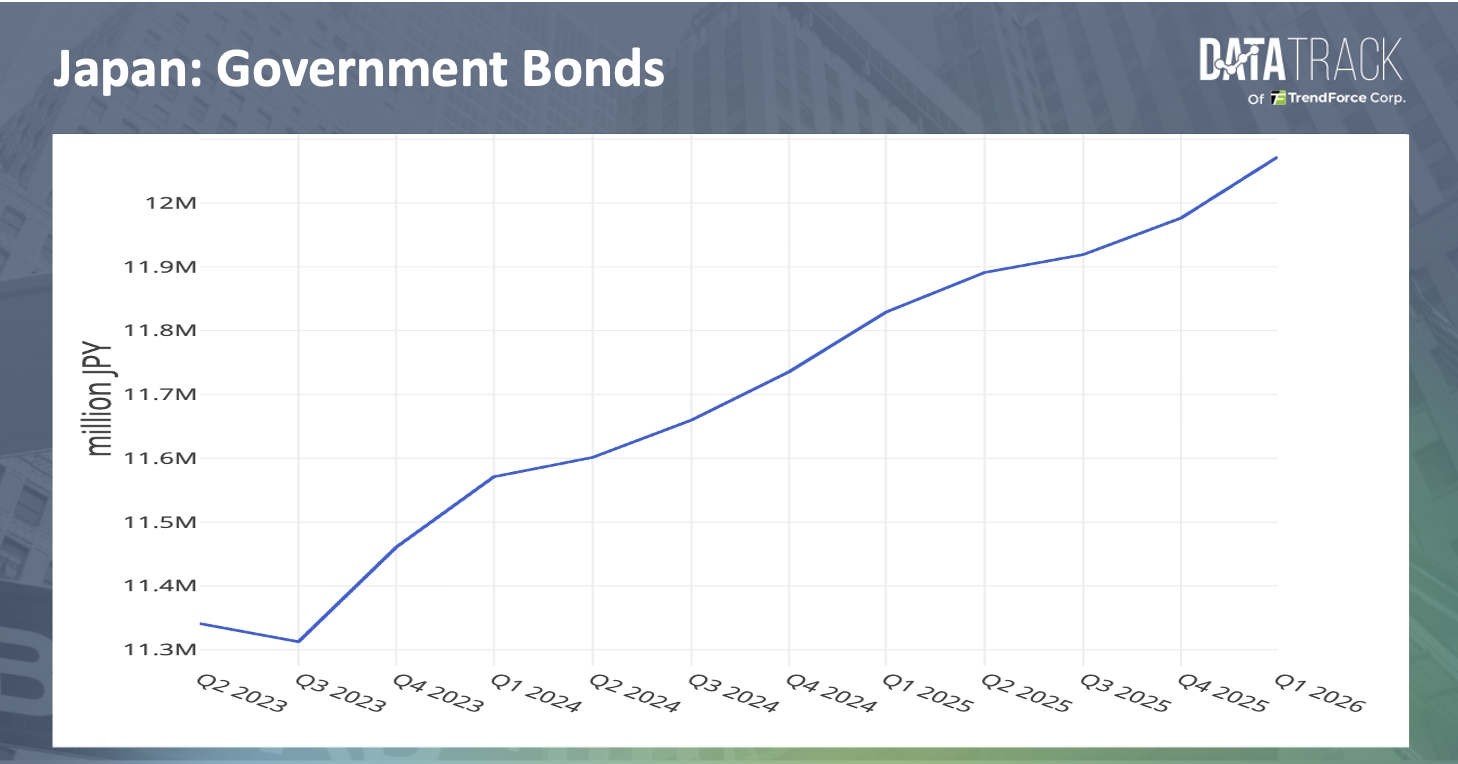
Japan’s bond market has recently become a focal point for global markets. On July 9, the yield on Japan’s 10-year government bond (Japanese Government Bond, JGB) rose to 2.9%, reaching its highest level in about 30 years. It also increased for the ninth consecutive trading day, marking the longest rising streak in nearly 20 years. Selling pressure also expanded across long-dated and super-long-dated bonds, with 30-year and 40-year JGB yields both rising to around 4%. This shows that the pressure no longer reflects only changes in short-end policy rate expectations, as the entire yield curve is being repriced.
Rising bond yields mean falling bond prices. If this were only a short-term interest rate fluctuation in a single country, it would usually not attract such high attention from global markets. However, Japan’s long-standing low-rate and weak-yen environment has served as an important underlying condition for global capital circulation for decades. As Japan’s long-end yields rise rapidly, markets are reassessing whether the Japanese government can withstand higher borrowing costs, whether the Bank of Japan (BOJ) can independently control inflation, and whether Japanese capital will flow back from overseas markets into domestic assets.
Long-End Yields Hit Highs as Markets Reassess Japan’s Fiscal and Inflation Risks
From the perspective of the yield curve, pressure in Japan’s bond market is concentrated at the long end and super-long end, and has already been reflected in a steepening of the curve. On July 8, the yield spread between 10-year and 2-year JGBs widened to about 143 basis points, the highest level since 2004, reflecting rising market concerns over long-end inflation and price risks, while expectations for BOJ rate hikes at the short end have also moderated. The following day, on July 9, Japan’s 10-year JGB yield rose further to 2.9%, reaching an approximately 30-year high. This indicates that investors are demanding a higher term premium to hold long-dated Japanese bonds, reflecting a reassessment of fiscal expansion, sticky inflation, and BOJ policy credibility.
| July 9 JGB Yield Indicator Data |
Latest Change |
Current Interpretation |
| 2-Year JGB Yield |
1.445% |
Reflects market pricing of the BOJ policy rate path |
| 10-Year JGB Yield |
2.900% |
Reached an approximately 30-year high, becoming the core focus of market attention |
| 20-Year JGB Yield |
3.890% |
Selling pressure on long-dated bonds has intensified |
| 30-Year JGB Yield |
4.030% |
Super-long-end yield has risen above 4% |
| 40-Year JGB Yield |
4.055% |
Long-term fiscal risk premium is rising |
Fiscal Expansion and Import Inflation Drive Bond Market Selling Pressure
The core background behind this wave of JGB selling pressure is the simultaneous rise in fiscal expansion and inflation pressure. The government of Japanese Prime Minister Sanae Takaichi is promoting a long-term investment plan of more than JPY 370 trillion, equivalent to about USD 2.28 trillion based on the exchange rate at the time, covering areas such as AI, chips, and space development. The policy goal is to raise Japan’s growth potential through public and private investment. However, with Japan’s government debt already exceeding 200% of GDP, markets are more concerned about funding sources, bond issuance pressure, and fiscal discipline. When long-end interest rates rise, the Japanese government’s borrowing costs, interest expenses, and debt sustainability pressures also increase simultaneously.
Inflation pressure is making bond market concerns harder to ease. Middle East tensions and oil price volatility have pushed up global energy prices, while a weak yen has further increased Japan’s import costs. The latest data show that Japan’s June corporate goods price index rose 7.1% year over year, reaching its highest level in more than three years. Fuel prices rose 22.8% year over year, while yen-denominated import prices increased 29.7% year over year. If import prices and corporate costs continue to rise, they may further pass through to broader prices and increase pressure on the BOJ’s inflation and rate-hike path.
BOJ policy normalization is also facing a test of trust. In June, the Bank of Japan raised its short-term policy rate from 0.75% to 1%. However, language in the government’s economic blueprint involving coordination between monetary policy and growth targets had raised market concerns over whether the BOJ would keep interest rates low due to fiscal and growth pressures. The Japanese government later considered adding wording to the economic blueprint to respect BOJ independence, with the aim of reducing market concerns about political interference in monetary policy.
10-Year Yield Nears 3%, Debt Sustainability Becomes Market Focus
The 10-year JGB yield approaching 3% is viewed by the market as an important threshold because it may change the pricing assumptions for Japan’s debt costs. In the past, Japan was able to sustain a massive level of government debt largely because of low interest rates, stable holdings by domestic institutions, and long-term BOJ bond purchases that suppressed financing costs. As the 10-year yield approaches 3% and super-long-end yields rise to around 4%, markets are beginning to evaluate whether the Japanese government’s future bond issuance costs will rise faster than fiscal revenue. This is also why some strategists have compared Japan with the United Kingdom’s 2022 “Truss moment.” The key point is that markets are examining the trust foundation among Japan’s fiscal policy, central bank policy, and exchange rate.
Japan’s Long-Term Low-Rate Assumption Changes, Global Capital Allocation Needs Recalibration
The spillover effect of Japan’s bond market mainly comes from yen carry trades and Japanese institutional capital allocation. For a long time, low-cost yen funding has supported investors in buying overseas assets such as U.S. Treasuries, European bonds, high-yield bonds, and equities. When Japanese interest rates rise, the spread supporting carry trades narrows, and some leveraged positions may face deleveraging or unwinding pressure. On the other hand, Japanese investors have long been important buyers in global bond markets. As of April 2026, Japan held about USD 1.21 trillion in U.S. Treasuries, remaining the largest foreign holder of U.S. government debt. If JGB yields continue to rise, the attractiveness of domestic Japanese bonds will increase, and overseas bond allocations may undergo rebalancing, further affecting global bond yields and risk asset valuations.
Policy-level signals of capital repatriation are also emerging. On July 10, the Japanese government said it would study ways to encourage pension funds to increase investment in domestic financial assets, especially the Government Pension Investment Fund (GPIF), which manages JPY 293.4 trillion, or about USD 1.81 trillion, in assets. If this type of long-term capital adjusts its domestic and overseas allocation, the impact may not be limited to Japan’s bond market, but could also affect the supply-demand structure of overseas bond, equity, and foreign exchange markets.
Japan’s Bond Market Has Not Lost Control, but Global Sensitivity to Long-End Rates Has Increased
At present, it is still inappropriate to directly interpret selling pressure in Japan’s bond market as a global bond market crisis. Japan’s bond market still has a deep domestic investor base, and banks, insurers, pension funds, and the BOJ remain important participants. Even as long-end yields have risen rapidly, Japan’s 5-year government bond auction on July 9 remained relatively stable, with a bid-to-cover ratio of 3.43, slightly higher than the previous auction, showing that market demand has not disappeared completely.
From the perspective of global fixed income markets, capital has not fully withdrawn from bond assets. The more obvious change is that investors are reassessing interest rate risk, duration risk, and country allocation. Pressure in Japan’s bond market does not necessarily mean that all bonds will fall simultaneously, but it does increase the sensitivity of global long-end rates to repricing.
The Next Focus Will Be BOJ Policy Signals, the Yen, and Long-Term Capital Allocation
The key factors for Japan’s bond market going forward will be BOJ policy signals, yen movements, and whether Japan’s long-term capital allocation changes. If the BOJ can clearly maintain policy independence and preserve room for further rate hikes as inflation pressure rises, market concerns over out-of-control long-end inflation may ease. If investors believe the BOJ will delay rate hikes due to government fiscal pressure, long-end yields may continue to reflect higher risk compensation.
The 30-year high in JGB yields reflects that Japan is entering a new stage in which fiscal policy, inflation, and monetary policy are all being tested by the market at the same time. Japan’s bond market has not yet formed a systemic crisis, but it has already changed global capital’s pricing assumptions for Japan’s low-rate environment. Over the next few weeks, markets will continue to watch whether the 10-year JGB yield breaks above 3%, whether the BOJ releases a clearer policy path, and whether Japanese long-term capital begins to reallocate.