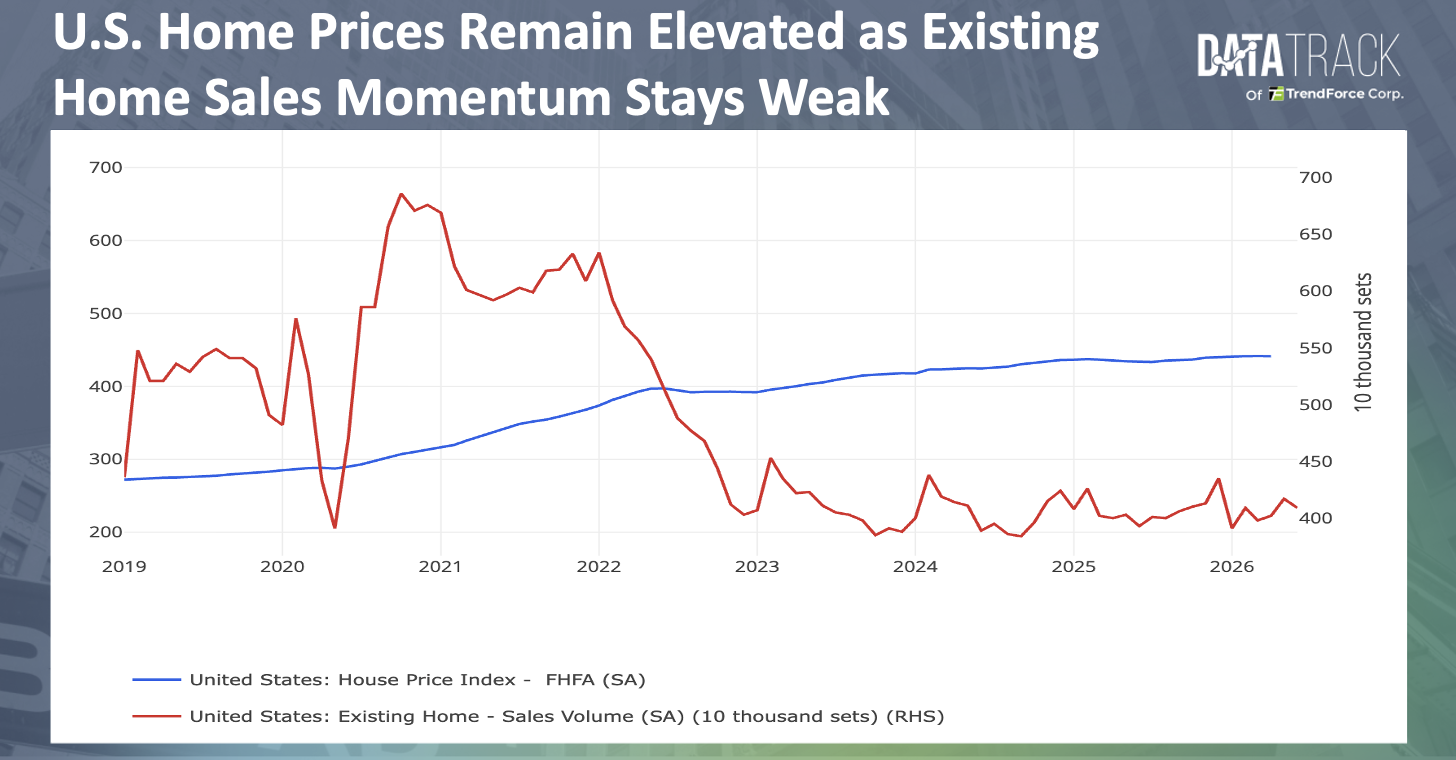
The U.S. housing market entered a distinctive phase in mid-2026, with transaction volumes declining while home prices continued to set new records. According to data from the National Association of Realtors (NAR), existing-home sales in June 2026 fell 2.4% month over month to a seasonally adjusted annual rate of 4.09 million units, below the market expectation of 4.20 million units. Compared with the same period last year, however, sales still increased slightly by 2.8%. The median existing-home sales price rose 1.8% year over year to US$440,600, reaching another record high.
The simultaneous decline in transactions and rise in prices shows that high interest rates are reducing market liquidity from both the supply and demand sides. Prospective buyers are postponing purchases because of elevated home prices and financing costs, while homeowners with low-rate mortgages are reluctant to sell or move. As both buyers and sellers retreat from the market, weaker demand has not immediately translated into broad price declines, while limited housing supply continues to support transaction prices.
High Home Prices and Mortgage Rates Are Jointly Suppressing Housing Demand
As of July 9, 2026, the average U.S. 30-year fixed mortgage rate stood at 6.49%, up from 6.43% in the previous week but below 6.72% a year earlier. Mortgage rates briefly fell below 6% at the beginning of 2026 before rising again, and have recently remained near 6.5%, making it difficult for monthly mortgage burdens to improve meaningfully.
The combination of high home prices and elevated interest rates has had the greatest impact on households with limited down payments and cash flow. First-time buyers accounted for 33% of existing-home transactions in June, up from 30% a year earlier, but still below the roughly 40% level commonly seen when the housing market is more active. Even small changes in mortgage rates can directly affect buyer decisions. When rates decline slightly, some demand temporarily returns, but purchasing activity cools rapidly when rates rise again, causing monthly sales data to fluctuate continuously.
The Mortgage Rate Lock-in Effect Is Causing Existing Homeowners to Delay Selling
High interest rates are also constraining the supply of existing homes. Many U.S. homeowners purchased properties or refinanced their mortgages during the pandemic and still hold fixed-rate loans below 5%. If they sell their current homes and purchase new ones, they must give up their existing low-rate mortgage terms and refinance at market rates close to 6.5%, substantially increasing the cost of moving.
Without job relocations, changes in household size, retirement, or financing needs, homeowners are generally more willing to remain in their existing properties. This mortgage rate lock-in effect reduces new listings and slows housing market turnover. At the end of June, the nationwide inventory of existing homes for sale stood at approximately 1.56 million units, down 0.6% from May and only 1.3% higher than a year earlier. At the current sales pace, the existing inventory represented about 4.6 months of supply.
Buyers are waiting because of limited affordability, while homeowners are withholding properties because their low-rate mortgages carry significant economic value. This keeps transaction volumes at low levels. Limited listings also mean that even when demand weakens, prices are unlikely to decline rapidly, forming the main structural basis of the current environment of lower sales and rising prices.
Existing-Home Supply Is Constrained, While the New-Home Market Faces Inventory Pressure
The mortgage rate lock-in effect is concentrated primarily in the existing-home market, while supply conditions in the new-home market are markedly different. Existing homeowners can choose to postpone selling, but builders have already committed capital to land, materials, and construction, and must generate sales to recover cash. As a result, they have greater difficulty maintaining previous prices and sales terms when demand weakens. Data from the U.S. Census Bureau and the Department of Housing and Urban Development showed that new single-family home sales fell to a seasonally adjusted annual rate of 580,000 units in May 2026, down 7.3% month over month and 6.8% year over year. New homes available for sale increased to 496,000 units, while months of supply rose from 9.3 months in the previous month to 10.3 months, far above the 4.6 months recorded in the existing-home market.
The higher inventory burden is forcing builders to offer price discounts, mortgage rate buydowns, closing cost assistance, or home upgrades to maintain sales momentum. Existing homeowners without an urgent need to sell can still maintain their asking prices or withdraw listings, so the new-home market generally offers greater room for negotiation. The U.S. housing market currently faces both a shortage of existing-home listings and an accumulation of new-home inventory, indicating that the supply problem has shifted from a single nationwide shortage to a clear mismatch across housing types and regions.
Record Existing-Home Prices Do Not Mean Home Prices Are Rising Nationwide
The record-high median existing-home sales price in June was also influenced by changes in the composition of transactions. As some first-time buyers and lower- and middle-income households exit the market, higher-income or cash-rich buyers can continue purchasing more expensive homes. The transaction mix therefore shifts toward higher-priced properties, pushing up the overall median. This figure is useful for reflecting the actual composition of transactions during the month, but it does not directly mean that the price of every home is rising.
The house price index compiled by the Federal Housing Finance Agency (FHFA) using repeat-sales data showed that nationwide home prices fell 0.1% month over month in April 2026, but still increased 2.0% year over year. This indicates that home prices have not entered a nationwide decline, although both price growth and short-term momentum have weakened significantly. This does not conflict with the record-high median existing-home sales price.
Regional differences are also continuing to widen. Texas, Florida, and some Sun Belt cities, where housing construction expanded significantly in recent years, are now facing rising inventories, higher insurance costs, and increasing property taxes, giving buyers gradually more bargaining power. In contrast, Northeastern cities with limited land supply and slower housing construction continue to receive stronger price support because listings remain scarce. Existing-home sales increased in the Northeast in June but declined in the Midwest, South, and West, further demonstrating the significant regional divergence beneath the national averages.
The Housing Market Lacks the Conditions for a Broad Collapse, but a Recovery in Transactions Will Take Time
The current U.S. housing market differs materially from the environment before the 2008 financial crisis. Most homeowners hold fixed-rate mortgages, while post-pandemic home price gains have also created a degree of housing equity. As long as employment and household income do not deteriorate sharply, homeowners can choose to continue holding their properties. Distressed transactions, including foreclosures and short sales, accounted for only 2% of sales in June, down from 3% a year earlier. The median number of days on the market for listed properties increased only from 27 days to 28 days, indicating that large-scale forced selling has not emerged.
However, the absence of selling pressure also means that price corrections will remain limited. High home prices, mortgage rates, property taxes, homeowners’ insurance, and maintenance costs will continue to restrict the ability of ordinary households to enter the market. Even if mortgage rates begin to decline, additional demand may first compete for a limited supply of existing homes, supporting prices. If builders reduce future housing starts because of weak new-home sales, the shortage of housing supply may continue over the medium to long term.
Whether Interest Rates and Supply Improve Together Will Determine the Housing Market Outlook
The main contradiction in the U.S. housing market in 2026 is the simultaneous presence of high financing costs, constrained existing-home supply, and accumulating new-home inventory. Record existing-home prices are primarily supported by limited listings and the composition of transactions, while new-home sales and inventory data show that some markets with greater supply are gradually shifting toward buyers.
Going forward, key indicators include whether the 30-year mortgage rate can continue to decline, whether new existing-home listings increase, the level of new-home inventory and builder incentives, and changes in employment and mortgage delinquencies. If interest rates fall but the supply of existing homes remains restricted by the lock-in effect, home prices may continue to consolidate at elevated levels. If employment weakens and forces more homeowners to sell, markets with higher inventory may experience more pronounced corrections.
The U.S. housing market remains in a low-liquidity adjustment phase, and weaker demand has not yet been fully transmitted into prices. For the market to move beyond the current pattern of lower sales and rising prices, financing costs must decline, existing homeowners must regain the willingness to move, new housing supply must become better aligned with demand, and household income must continue to improve. Small fluctuations in interest rates alone will not be sufficient to restore normal transaction activity.