The U.S. consumer market has recently shown a clear divergence. Nominal retail sales were broadly stable in June 2026, jobless claims remained low, and household credit conditions have not deteriorated across the board. However, consumers remain pessimistic about prices, job opportunities, and the economic outlook. This combination of relatively strong hard data and weak soft data indicates that U.S. households are still capable of maintaining spending, but concerns about future income and living costs are rising. Whether the U.S. economy is merely slowing gradually or approaching a more pronounced turning point will depend on whether weaker hiring eventually develops into higher unemployment and whether real income can continue to support consumption.
Retail Sales Growth Slows, but Underlying Consumer Demand Remains Resilient
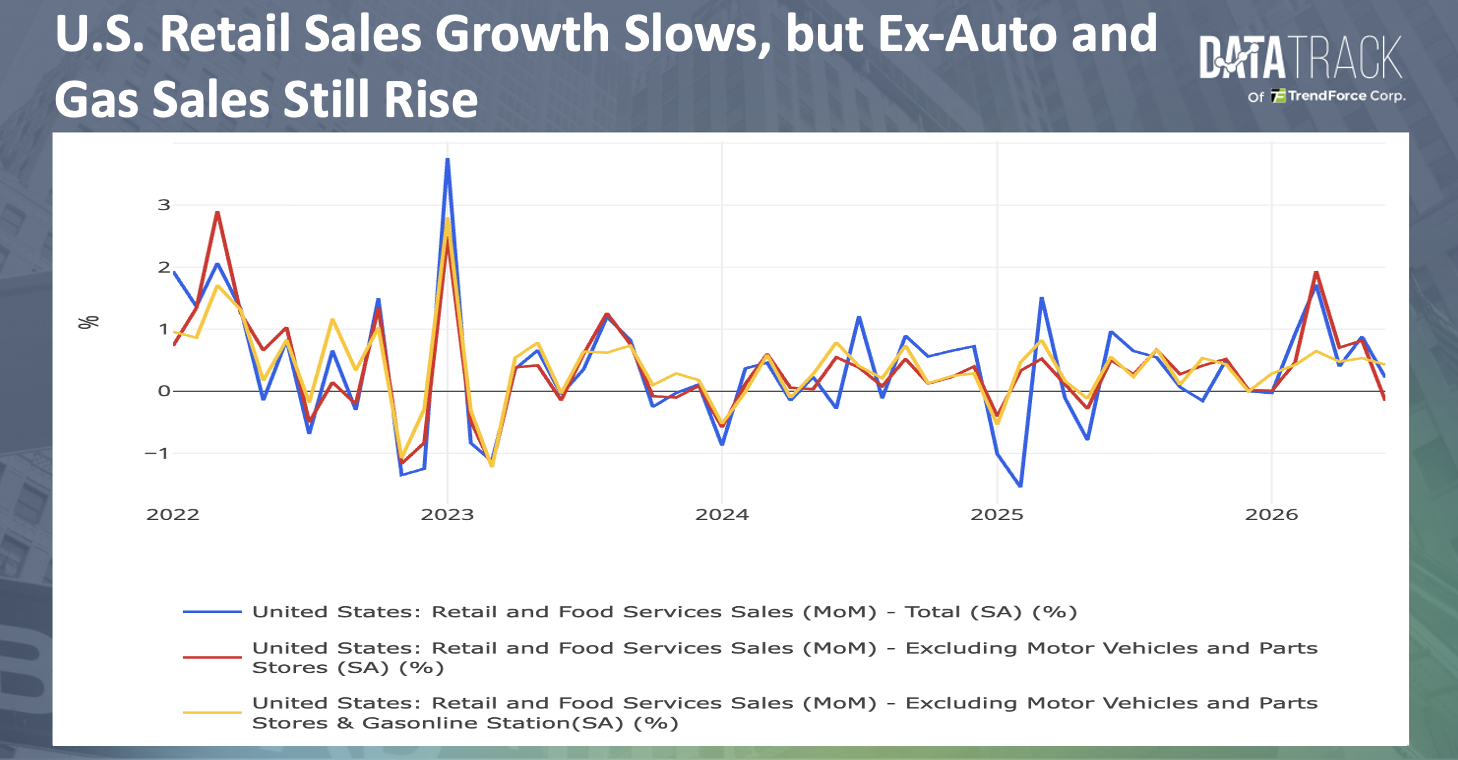
The U.S. Department of Commerce reported that retail and food services sales rose 0.2% month over month and 6.7% year over year in June 2026, below the upwardly revised 1.0% monthly increase in May. Although overall growth slowed, the main drag came from a 5.3% monthly decline in gasoline station sales, reflecting the effect of lower gasoline prices on nominal sales values.
Excluding gasoline stations, retail sales rose 0.7% in June. Excluding both motor vehicles and gasoline stations, sales still increased 0.4%. Sales at motor vehicle and parts dealers and nonstore retailers both rose 1.9% month over month, while nonstore retailer sales increased 14.2% from a year earlier, showing that e-commerce remains an important pillar of the retail market. If motor vehicles, gasoline stations, building materials, and food services are further excluded, the retail control group, which more closely corresponds to the consumption component used in gross domestic product calculations, rose by approximately 0.5% in June. This indicates that goods consumption continued to expand at the end of the second quarter and has not yet shown a clear loss of momentum.
However, performance was uneven across categories. Motor vehicles, e-commerce, and some recreational goods continued to grow, while clothing, food and beverages, and health and personal care were relatively weak. This suggests that promotions, price differences, and the necessity of goods are exerting a greater influence on consumer purchasing decisions.
Consumers Are Still Spending, but Are More Pessimistic About Employment and Living Costs
Actual retail data reflect spending that has already taken place, while consumer confidence incorporates households’ expectations for future income, employment, and prices. The two can therefore move in different directions over the short term. The Conference Board’s Consumer Confidence Index edged up from a downwardly revised 90.6 to 91.2 in June, but the Present Situation Index, which reflects consumers’ assessment of current business and labor market conditions, declined to 116.4. The share of consumers who said jobs were hard to find rose from 19.8% to 22.5%, the highest level since early 2021, showing that concerns about the employment outlook are continuing to rise.
The University of Michigan’s Consumer Sentiment Index rose from 44.8 to 49.5 in June, but remained 18.5% lower than a year earlier. More than half of respondents continued to mention that high prices were eroding household finances. The CPI fell 0.4% month over month in June, while the core CPI was unchanged from the previous month, confirming that inflation had cooled. However, headline CPI still rose 3.5% year over year, while core CPI increased 2.6%. A lower inflation rate only means that prices are rising more slowly. The high price level accumulated over the past several years remains in place, so the improvement in official inflation data has not yet fully translated into better household living conditions.
The Labor Market Has Entered a Low-Hiring, Low-Layoff Phase
The labor market is central to whether consumption can be sustained. U.S. nonfarm payrolls increased by only 57,000 in June, while job gains for April and May were revised down by a combined 74,000, indicating that corporate hiring appetite is weakening. Job openings remained at 7.594 million in May, but the hiring rate was only 3.3%, while the quits rate also remained low, reflecting a simultaneous slowdown in both corporate recruitment and worker mobility. Meanwhile, the unemployment rate remained at 4.2% in June. Initial jobless claims fell to 208,000 in the week ended July 11, indicating that companies have not yet begun broad-based layoffs.
The labor market is currently closer to a low-hiring, low-layoff environment. Most households still have jobs and wage income, so consumption is unlikely to fall sharply in the immediate term. However, greater difficulty finding work may encourage households to shift toward discounted products, postpone major purchases, and reduce discretionary spending. If both initial and continuing jobless claims continue to rise, weaker hiring could begin to transmit more clearly to income and consumption.
Consumer Resilience Masks Income and Asset Divergence
The resilience of overall U.S. retail sales is also partly related to differences in income and asset ownership. High-income households account for a larger share of total consumption, while the wealth effect generated by rising equity prices can support spending on travel, dining, motor vehicles, and online shopping. Low- and middle-income households are more exposed to the costs of food, housing, insurance, and energy.
The Federal Reserve’s July Beige Book noted that some regions benefited from World Cup-related demand for dining, accommodation, and tourism. However, several regions also reported that consumers were cutting discretionary spending or switching to cheaper alternatives. The economic benefits of the World Cup were concentrated in specific cities and industries and therefore cannot represent the daily consumption conditions of U.S. households as a whole.
Household credit data have not shown a broad deterioration. Total U.S. household debt reached US$18.8 trillion in the first quarter of 2026, while the overall delinquency rate remained at 4.8%. However, serious delinquency rates among some credit card borrowers remained higher than a year earlier, indicating that financial stress has become more concentrated among households with weaker repayment capacity.
U.S. disposable personal income rose 0.7% month over month in May, while real consumer spending increased 0.3%. However, the personal saving rate was only 3.0%. Average hourly earnings rose 3.5% year over year in June, broadly in line with the annual increase in CPI, indicating that improvements in real wage purchasing power remained limited. Households can still rely on income to support spending, but the low saving rate leaves them with less room to absorb unemployment, a rebound in energy prices, or a correction in asset prices.
The U.S. Economy Appears Closer to the Late Stage of Expansion, but a Full Recession Signal Has Not Yet Formed
U.S. real GDP grew at an annualized rate of 2.1% in the first quarter of 2026, meaning that the economy remained in expansion. However, real final sales to private domestic purchasers increased by only 1.7%, showing that the pace of domestic demand growth had slowed. Retail sales, real income, jobless claims, and household credit data have not yet shown the synchronized deterioration typically seen during a recession. Weak consumer confidence alone is also insufficient to prove that the economy is about to contract.
Nevertheless, slower hiring, downward revisions to employment data, a low saving rate, and reduced discretionary spending among low- and middle-income households all exhibit some characteristics of the late stage of an economic expansion. Based on the current data, the U.S. economy appears closer to a period of slower growth and gradual cooling and has not yet entered a recession characterized by simultaneous deterioration in consumption, income, and employment. Going forward, attention should focus on whether initial and continuing jobless claims continue to rise, whether retail growth can broaden beyond e-commerce and motor vehicles, and whether real income can improve steadily. If consumption growth remains concentrated in a small number of categories and among high-income households, the overall economy will become more sensitive to changes in employment and asset prices.
Cooling Inflation and Resilient Consumption Allow the Federal Reserve to Remain Patient
The Federal Reserve currently maintains the federal funds rate target range at 3.5% to 3.75%. The easing of core inflation in June reduced the need for further tightening, but resilient retail sales and a stable unemployment rate also mean that the Federal Reserve lacks an urgent reason to cut rates rapidly.
Energy prices are one of the key variables. Lower gasoline prices in June improved both inflation and household cash flow. If renewed tensions in the Middle East push oil prices higher again, energy spending could once more compress household disposable income and increase the risk of a rebound in inflation, making the Federal Reserve’s policy assessment more complicated. Overall, U.S. consumption has not yet lost momentum, but whether its resilience can continue will depend on whether weaker hiring develops into higher unemployment and whether real income can continue to support household spending.